The Capstone Comeback: Microturbines Plus Creates New Future Path for Microgrid Partner
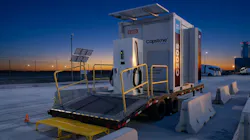
Nearly 40 years ago, a new company emerged out of the fast-lane misdirection of automakers who wanted to power cars with turbine drivetrains. Fifteen years later, the car industry abruptly took the off-ramp and exited the idea.
This fledgling company took the discarded innovation and ran with it, adapting microturbine systems into stationary power generation, including its first 1-MW system unveiled in 2007 in California. The company then known as Capstone Turbine created a fleet providing combined heat and electric power (CHP) for customers such as remote oil and gas operators, landfill gas power plants and, eventually, many types of commercial and industrial energy end users.
Capstone Turbine became Capstone Green Energy, collected more customers across many sectors, ran smack dab into market headwinds, declared Chapter 11 bankruptcy, reorganized, survived and changed its name again to reflect a sustained long-term purpose providing a variety of energy services for growing electrification in the U.S. and abroad.
Take a breath. That’s a lot of upheaval but all is well.
Energy Plus describes hybrid energy-as-a-service strategy

Now rebranded and repurposed this year as Capstone Energy+, the move garnered enough attention to merit a Los Angeles Times story on the name change. The durable California power generator is busy working on projects as diverse as oil refining in Chile to backup power for hospitality destinations in Utah and CHP for mission-critical end users such as Scripps Mercy Hospital in San Diego.
Healthcare, power generation and industrial electrification demands are driving its new mission, and you can’t get much more diverse than that.
“With today’s new energy renaissance, we have to look with a broader lens, not just power but energy as a whole,” Capstone Energy+ CEO Vince Canino said in an exclusive interview with Microgrid Knowledge.
The company’s well-known microturbine product was its bread and butter in meeting the on-site power needs of multiple and varied commercial and industrial customers through the years. Resiliency was the driver then, but energy efficiency and sustainability are desired goals in other ways, too.
“Sometimes microturbines are the right application, other times it’s something that doesn’t throw off as much thermal energy, but today emissions and redundancy have become a bigger part of the equation,” Canino added. “We’re that and more.”
Capstone’s re-emergence on the Nasdaq trading market provides a major sign of progress, though the company’s regained momentum began well before the relisting. The company, under its former Capstone Green Energy moniker, was still securing multiple projects utilizing its microturbine technology.
These days, Capstone Energy+ is expanding in new growth markets with its broader distributed energy solutions strategy to include a variety of correlated energy products and broader financial offerings under it energy-as-a-service application which helps end users avoid huge upfront installation costs while creating energy certainty.
This opens the doors to many commercial and industrial fronts. Data centers, of course, are on the table and maybe front and center—we almost feel contractually obligated to mention AI in every story now—but Canino and his team see great demand possibilities with mission critical customers such as hospitals, pharmaceuticals, ports and logistics.
Ports of call: New frontier for on-site electrification power
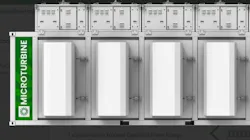
Ports may provide one of the biggest opportunities beyond behind-the-meter projects for AI-enabled data centers. Globally-engaged ports such as Los Angeles, Long Beach, Galveston, Texas; Bellingham, Wash., and Cleveland are wading into the long-term commercial and industrial energy transition with projects electrifying operations such as vehicle fleets to warehouses.
“We see some exciting things around the perimeter, mainly ports,” the Capstone CEO said. “They are electrifying but lacking the necessary infrastructure. They need a bridge solution.”
Enter flexible resources such as microturbines paired with battery storage and required electrical infrastructure. Ports around the world are seeking decarbonization strategies, which microgrids and distributed energy resources can provide.
By any name Capstone has traditionally kept its own counsel in developing on-site power solutions for individual customers. The looming Industrial Compute Age, which attracts a daunting amount of future load needs from the digital sector, requires another broader vision which does not try to get around the utilities, but instead aims to collaborate and make the grid stronger at the edge.
“How do we help utilities continue to be a part of the energy renaissance?” Canino asked. “How do we help them get the capacity that they can count on?”
Batteries, for instance, are so versatile they can offer black-start capabilities for gas-fired assets needed as peaker plants. They also deal with extreme fluctuations in load from AI training models.
“Resource adequacy, that’s an area we’re developing more and more,” Canino said. We’ve hired WSP, one of the largest engineering firms in North America, to help us develop a multi-front battery strategy.”
Capitalizing on renewed momentum
Capstone Energy+ re-started its trading on the Nasdaq Global Select Market on July 8 under the ticker symbol CEPL. This elevated it from the over-the-counter markets where it had existed since post-bankruptcy reorganization in 2023.
About three months earlier, investor Monarch Alternative Capital LP led a $112.5 million funding round to strengthen the Capstone ledger take leadership roles through board positions. This year alone, the company has announced new orders in North Carolina, Brazil, Utah, Chile and West Africa.
Gross profits topped $8.8 million and operating cash flow generated $5.4 million in the first fiscal 2027 quarter ending June 30. Capstone’s fiscal 2026 revenue increased 24% year over year to $106 million.
“Our first step was getting to profitability and bringing in an investment banker who understood the long-term strategy,” Canino pointed out.
Automakers who tried microturbines in 1980s and ‘90s such as Toyota, GM and Honda didn’t see the mobility play in small turbines, but other sector dreamers recognized an equitable conversion potential in stationary power. Canino and Capstone are still fully committed to the concept of behind-the-meter microturbine technology, which can perform on multiple fuel resources including waste gas while featuring air bearing technology which potentially creates a more seamless and low-emissions engine.
“Low friction means low noise. No lubricants mean no oil carryover to contaminate the fuel process, which gives us super low emissions,” Canino said. “We’re inverter-based so in a sense we’re grid enhancing.”
Behind-the-meter installations for MW and GW-scale power generation are almost certainly going to grow as data centers and industrial firms try to speed up the power connection process and get around grid constraints. The only question is where on-site generators such as Capstone Energy+ fit into the upswing.
“Behind the meter, that’s where I see customers going more and more,” Canino agreed. “Your biggest hurdle is the air permit. I think it starts small but it’s going to significantly grow.”
How to talk to your CFO about Batteries and Microgrids. . .
. . . Without Losing the Room
New Perspective from ELM Microgrid
About the Author
 Rod Walton, Microgrid Knowledge Managing Editor
Rod Walton, Microgrid Knowledge Managing Editor
Managing Editor
For Microgrid Knowledge editorial inquiries, please contact Managing Editor Rod Walton at [email protected].
I’ve spent the last 18 years covering the energy industry as a newspaper and trade journalist. I was an energy writer and business editor at the Tulsa World before moving to business-to-business media at PennWell Publishing, which later became Clarion Events, where I covered the electric power industry. I joined Endeavor Business Media in November 2021 to help launch EnergyTech, one of the company’s newest media brands. I joined Microgrid Knowledge in July 2023.
I earned my Bachelors degree in journalism from the University of Oklahoma. My career stops include the Moore American, Bartlesville Examiner-Enterprise, Wagoner Tribune and Tulsa World, all in Oklahoma . I have been married to Laura for the past 36-plus years and we have four children and one adorable granddaughter. We want the energy transition to make their lives better in the future.
Microgrid Knowledge and EnergyTech are focused on the mission critical and large-scale energy users and their sustainability and resiliency goals. These include the commercial and industrial sectors, as well as the military, universities, data centers and microgrids. The C&I sectors together account for close to 30 percent of greenhouse gas emissions in the U.S.
Many large-scale energy users such as Fortune 500 companies, and mission-critical users such as military bases, universities, healthcare facilities, public safety and data centers, shifting their energy priorities to reach net-zero carbon goals within the coming decades. These include plans for renewable energy power purchase agreements, but also on-site resiliency projects such as microgrids, combined heat and power, rooftop solar, energy storage, digitalization and building efficiency upgrades.