Hope Remains, Yet No Certainty Federal Funding Ordered by Judge for Healthcare Microgrids will be Awarded

Jonathan Lewis is hopeful that a new microgrid for a mission-critical hospital and school in Washington state will move forward, but he's not holding his breath that the Trump Administration will reinstate federal funding for the project.
Lewis, the director of support services at Klickitat Valley Health–which has proposed a community microgrid that would provide resilience for the hospital and a nearby school in Goldendale, Wash.--is waiting to hear if the Federal Emergency Management Agency (FEMA) will take a recent judge’s order seriously requiring the administration to reinstate BRIC funding for resilience projects.
On Dec. 26, U.S. District Court Judge Mary S. McElroy ordered the Trump administration to give back grants to disaster-prevention projects across the country that the administration had clawed back. This includes microgrid projects in Washington and Oregon and across the country.
In April, when grant recipients had already begun projects, the administration stopped funding for Building Resilient Infrastructure and Communities (BRIC) grants, which are distributed by FEMA.
Is the federal government stalling grant distribution?
“The federal government is probably slow-rolling this, I’m not holding my breath,” Lewis said of the fund-reinstatement order. Klickitat Valley Health was initially granted $9.8 million in BRIC funding for the $20 million project, and had secured grants from the Washington Department of Commerce and from the Washington Emergency Management Division. In addition, by purchasing the solar panels by the end of 2025, the hospital became eligible to receive the federal Investment Tax Credit.
The project is important to the school and hospital because the south-central Washington area lies at the eastern end of the Columbia River Gorge and is subject to frequent storms that can isolate the hospital from larger cities during power outages. During these storms, it’s common to have trouble sourcing diesel for generators. Other risks include wildfires, utility public safety power shutoffs and earthquakes.
Columbia River Gorge Faces Wildfire Risks
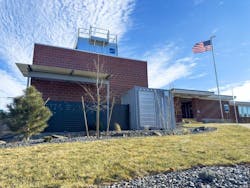
“There’s a huge wildfire risk up and down the Columbia River Gorge and all utilities have curtailment plans in place if high winds stoke the possibility of wildfires,” Lewis said.
The project would support the hospital and school, as well as other hospitals to the West. The school district, which has served as a command center in Goldendale during fires, would become a resilience hub.
Initially, the hospital proposed two microgrids that could connect via a hospital-owned high-voltage line between the campuses and run as one microgrid. The hospital’s utility, Klickitat Public Utility District (PUD) didn’t like that idea, arguing that the hospital would be serving as a utility.
The hospital pivoted, saying it would only intertie the school and hospital campus microgrids together during extended outages, and Klickitat PUD would have control of reconnecting to the grid. The PUD approved that plan.
While the project could have been off-grid, the hospital recognized the benefits of net metering or sending power to the grid during normal operations, he said.
Goldendale has a high poverty rate, and an extended outage would make homes unlivable, Lewis added.
A resilience hub at a local school
“Partnering with the school would allow the hospital to continue to be a hospital and the school could provide command-center functions,” Lewis said.
Klickitat Valley Health’s microgrid project is one of a number of projects that had BRIC funding pulled by the Trump administration and then reinstated by Judge McElroy.
Eight Oregon projects have sunk $8 million to date
The federal share of BRIC projects in Oregon is $140 million for 26 projects, and the local matching share of these projects totals $90 million. Eight of those projects have $8 million in sunk costs, said Erin Zysett, Oregon Department of Emergency Management public information officer.
FEMA has not yet issued final guidance in response to the court ruling saying the BRIC cancellation is unlawful. The federal government has 60 days to appeal, and states are awaiting clarification. No final determinations have been made regarding individual projects, she added.
Delays may raise project costs, she said.
“Due to funding delays and their effect on project timelines, even if the grants were reinstated, some projects will be priced out as they locked cost estimates years ago when inflation and tariffs were lower, but those locked-in prices are set to expire and the new cost could be significantly higher,” Zysett said.
BRIC funding is critical because it allows for proactive investments to reduce disaster risks before crises occur–the only pre-disaster funding available.
It’s especially important in Oregon, which faces high earthquake risks, wildfire threats and flooding hazards that make the funding essential for public safety, she said.
Every $1 spent on hazard mitigation saves $6 to $10 in future savings
“Loss of BRIC funding could result in delayed safety improvements, higher local costs and increased vulnerability for communities statewide,” she said. Every $1 spent on hazard mitigation saves $6 to $10 in future disaster recovery costs, depending on the type of project and hazard, she added.
Not only is the cancellation of the BRIC grant program slowing projects. The enhanced review process implemented by the Department of Homeland Security (DHS) in February 2025 requires a manual review and approval by DHS Secretary Kristi Noem for any FEMA grants that exceed $100,000. That has created funding-approval delays for mitigation grants.
How delays create risks
One example is a project that aims to speed up grant implementation through the Hazard Mitigation Grant Program for solar-plus-storage microgrids in Oregon. The project calls for a team to work with at least 12 communities, collecting data, evaluating and prioritizing sites, and conducting feasibility studies for up to 100 critical facilities and resilience hubs.
“Budgets and timelines for both phase one and two of this study are currently jeopardized by delays caused by this enhanced review process implemented by DHS,” Zysett said.
For the Klickitat Valley Health, if BRIC funding doesn’t come through, Lewis plans to seek other sources of funding, possibly through Washington state’s Climate Commitment Act, Lewis said.
“We will continue to try to piecemeal funding together,” Lewis said.
About the Author
 Lisa Cohn
Lisa Cohn
Contributing Editor
I focus on the West Coast and Midwest. Email me at [email protected]
I’ve been writing about energy for more than 20 years, and my stories have appeared in EnergyBiz, SNL Financial, Mother Earth News, Natural Home Magazine, Horizon Air Magazine, Oregon Business, Open Spaces, the Portland Tribune, The Oregonian, Renewable Energy World, Windpower Monthly and other publications. I’m also a former stringer for the Platts/McGraw-Hill energy publications. I began my career covering energy and environment for The Cape Cod Times, where Elisa Wood also was a reporter. I’ve received numerous writing awards from national, regional and local organizations, including Pacific Northwest Writers Association, Willamette Writers, Associated Oregon Industries, and the Voice of Youth Advocates. I first became interested in energy as a student at Wesleyan University, Middletown, Connecticut, where I helped design and build a solar house.
Twitter: @LisaECohn
Linkedin: LisaEllenCohn
Facebook: Energy Efficiency Markets