Tribe-Owned Developer Sees Economic Opportunities in Siting Microgrid-Powered Energy Park for Data Centers
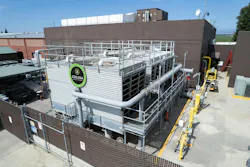
Colusa Indian Energy, which is 100% owned by the Cachil Dehe Band of Wintun Indians, plans to leverage its experience running an off-grid microgrid to create an energy park for data center developers and other large loads on tribal land in Northern California.
The park will be located on land owned by the Cahill Dehe Band and will be off-grid at first, taking advantage of surplus power from the tribe’s existing 6-MW off-grid microgrid and avoiding long interconnection queues. The developer plans to add off-grid generation, ultimately totaling 100 MW, said Kevin Blaser, vice president, business development at Colusa Indian Energy.
The project will connect to the grid, possibly in 3-7 years, when interconnection is available.
Colusa Indian Energy partners with data center developer
Colusa, which will create the energy infrastructure and provide the power for the park, has partnered with data center developer Strata Expanse to create the AI and energy infrastructure campus. This includes deploying a center of excellence, which will be a facility designed for research into next-generation AI workloads. The center is expected to be an incubator for advanced computational models.
“The center allows companies to test their systems before deploying them on a massive scale,” Blaser said. A larger data center may be sited at the park in the next phase of development, and the total off-grid generation capacity could reach 100 MW as the developer adds tenants to the park.
Economic opportunities for the Cachil Dehe Band of Wintun Indians are expected to include lease payments, revenue-sharing agreements with data centers, income from providing grid services, and employment opportunities for tribal members. The tribe expects to create training programs for tribal members and hopes that members who have moved away will return to take advantage of these opportunities. Traditionally, agriculture has been the main source of income for tribal members, Blaser said.
Existing microgrid comprised of cogeneration plant and solar
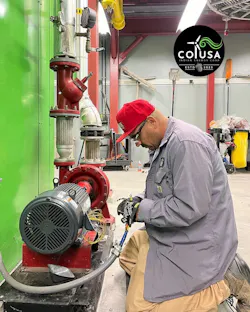
The existing 22-year-old microgrid includes 1.5 MW of solar located on the roofs of a casino and hotel, plus a natural-gas-fired cogeneration plant that powers the casino, hotel, tribal administration and homes. The cogeneration plant provides hot and cold water for the casino and hotel complex. The microgrid has its own underground distribution system built by Colusa.
Colusa Indian Energy grew out of concerns about power outages. In 2003, the tribe experienced 50 to 60 outages a year, which prompted the tribe to form the for-profit company to develop the microgrid.
“It was a competitive advantage for gaming. Other casinos shut down because of a lack of power,” Blaser said. The tribe hasn’t had an outage in 14 years.
Colusa Indian Energy is now talking to 80-90 tribes about building microgrids, and is developing two projects on tribal lands, he said.
Strata Expanse will raise the capital for the data center and the energy park.
Developers’ plans to address environmental challenges include renewables
To address the environmental challenges associated with data center development, Colusa Indian Energy will include renewables–possibly geothermal and solar–while minimizing emissions from natural gas generators, he said. Carbon emissions reduction will be achieved through pre- and post-combustion equipment.
To prevent excessive water use in the data center, the project will use a closed-loop system that reuses water.
Many data center developments are facing opposition over environmental concerns. For example, in response to community outcry, developers of Project Jupiter, a massive AI data center campus under construction in southern New Mexico, are ditching gas turbines and diesel generators in favor of fuel cells.
Oracle and BorderPlex Digital Assets, the companies behind the $165 billion project, recently announced the project’s updated power design.
Bloom Energy, a provider of fuel cell power options, will provide up to 2.45 GW of fuel cell capacity for the site, eliminating the need for the previously announced fleet of on-site turbines and generators. The move will significantly lower the site’s emissions and water consumption.
Energy park will benefit the tribal community and data center developers
For Colusa Indian Energy, the energy park is all about meeting the needs of the tribal community while addressing interconnection delays that stymie data center developers, Blaser said.
“The biggest piece is the tribe using its land base and experience operating microgrids to meet a market need where there aren’t any solutions,” he said. Data centers strain the grid and are experiencing higher costs due to interconnection delays, he added.
“A lot of that will be eliminated because we can build power without a utility connection and because of our experience maintaining constant power. This solves the problem of data centers needing power 24/7. We can deliver that within the tribes’ trust land,” Blaser said.
When the Grid Can't Wait: Unlocking Existing Solar Capcity with DC-Coupled Storage
New Insights from ELM Microgrid
About the Author
 Lisa Cohn
Lisa Cohn
Contributing Editor
I focus on the West Coast and Midwest. Email me at [email protected]
I’ve been writing about energy for more than 20 years, and my stories have appeared in EnergyBiz, SNL Financial, Mother Earth News, Natural Home Magazine, Horizon Air Magazine, Oregon Business, Open Spaces, the Portland Tribune, The Oregonian, Renewable Energy World, Windpower Monthly and other publications. I’m also a former stringer for the Platts/McGraw-Hill energy publications. I began my career covering energy and environment for The Cape Cod Times, where Elisa Wood also was a reporter. I’ve received numerous writing awards from national, regional and local organizations, including Pacific Northwest Writers Association, Willamette Writers, Associated Oregon Industries, and the Voice of Youth Advocates. I first became interested in energy as a student at Wesleyan University, Middletown, Connecticut, where I helped design and build a solar house.
Twitter: @LisaECohn
Linkedin: LisaEllenCohn
Facebook: Energy Efficiency Markets