Blurred Lines: Environmentalists Upset about Lack of Clarity in Gas-fired Microgrid Plans to Power New Mexico Data Center

Discussions about powering data centers often focus on ensuring power is renewable. Clean microgrids can help achieve that goal.
For example, representatives from Intel, Google and Amazon described their need for resilience and clean energy at a data center and energy conference held in July. Microgrid proponents described microgrids as an important solution to both challenges.
A report from microgrid modeling technology firm Xendee, “A Guide to Meeting Energy Demand for Data Centers with Distributed Energy and Future Small Modular Reactors,” found that deploying microgrids for data centers using a multi-year approach would reduce reliance on utility electricity and lower costs.
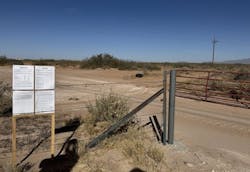
But a proposal from BorderPlex Digital Assets to site a $165 billion--yes, $165 billion--data center complex powered by an off-grid, natural-gas-fired microgrid in Doña Ana County, N.M. bucks this trend and has sparked opposition from environmental groups and residents who are worried about the complex’s impact on air quality and water resources.
BorderPlex and its partner Stack Infrastructure have proposed building the campus on about 1,400 acres of vacant land near the Mexican border.
In September, the Doña Ana County Board of Commissioners approved the project. To attract the project developers, the county had agreed to no property taxes and no taxes on equipment acquired to build the data centers, including servers and networking gear.
The project also calls for an initial $50 billion investment in the data center campus within five years, and up to $165 billion over a 30-year financing term.
The Doña Ana Board of County Commissioners also approved an ordinance to issue and sell Industrial Revenue Bonds for Project Jupiter.
The approval gave BorderPlex Digital Assets a 30-year exemption from property taxes in exchange for annual payments of $12 million to the county.
Project developer claims most residents support Project Jupiter
At a Sept. 19 county commissioners meeting, Lanham Napier, chairman of BorderPlex Digital Assets, said the company had held five educational meetings in each of the county’s five districts to respond to questions from community members.
He said his company had made 120,000 calls to county residents, and 83% were in favor of the project, with 17% against it. The project, he said, will create 150 permanent onsite jobs, plus 50 part-time roles and construction jobs could number 2,500.
Napier did not respond to a request for comment by deadline.
In February, New Mexico Gov. Michelle Lujan Grisham announced the state’s partnership with BorderPlex Digital Assets to support the project.
BorderPlex is collaborating with New Mexico State University to uncover water management solutions and possibly reinforce the university’s efforts focused on water management, technical training and AI. The company is also partnering with EPCOR, a private water supplier, to study possibly developing a water desalination project in Santa Teresa, where the data center campus will be built.
Lujan Grisham said New Mexico’s partnership with BorderPlex bolsters the state’s reputation as a national leader in advanced manufacturing and global trade. It provides digital infrastructure that will benefit the state’s economy, she said.
Two microgrids proposed to allegedly avoid regulation
Colin Cox, senior attorney at the Center for Biological Diversity Law Institute, said the developers have split the microgrid portion of the project into east and west microgrids to sidestep federal environmental regulations that restrict the release of pollutants. That’s happening in a county that’s already struggling with high emissions and water challenges.
Sunland Park, located in the county, is subject to unhealthy ozone levels, he said. It doesn’t meet the Clean Air Act criteria. For this reason, any new source that will boost ozone levels should be subject to additional restrictions.
“They are proposing two totally separate pollutant sources, claiming they’re separate because they’re not on continuous land,” Cox said. “But when turbines by the same owner power facilities, it doesn’t matter if there’s a small bit of land between two power plants; it should be counted as one source.”
The pollutant threshold for this kind of plant is 250 tons, and the developers’ application describes two microgrids that would each produce 249.9 tons annually.
“By coming in at 249 tons, they claim it’s two minor sources,” he said.
Microgrid would emit ozone-producing nitrogen oxides
Environmentalists are most concerned about the plant's emissions of nitrogen oxides and volatile organic compounds, Cox said.
With the two microgrids counted as one, they will release 498 tons of nitrogen oxides, which is significantly above the threshold set by the Clean Air Act, he said.
“That’s a huge problem, it basically means they are going to cause a significant impact to the ozone levels when people are already breathing too much in the area,” he said.
New Mexico’s Energy Transition Act established a statewide renewable energy goal of 50% by 2030 for New Mexico investor-owned utilities and rural electric cooperatives and a goal of 80% by 2040.
But HB 93, passed earlier this year, allows sole-source microgrids that don’t sell electricity to a utility to be exempt from the act.
Possible gas pipeline creates concerns
In addition, the project has sparked discussions about the developers possibly building a pipeline from one side of the state to the other to provide the needed gas, said Kacey Hovden, staff attorney at the New Mexico Environmental Law Center.
“One spill and it affects the water supply,” she said.
A pipeline from one side of the state to the other would also have to go through the national forest.
“We would fight. There’s so much potential for contamination and leakage,” said Daisy Maldonado, director of Empowerment Congress of Dona Ana County.
Water worries in a county grappling with drought
A major concern about the project, in addition to the microgrid's emissions, is its water use in a county already struggling with water scarcity. The data center campus will use 20,000 gallons of water a day, and the microgrid will consume the same amount, Napier said. The company has committed to spending $50 million on water projects, he said.
“We can’t even deliver safe and clean water to people now,” said Maldonado. When the project was proposed, she was already working to provide safe, clean water because the county was experiencing a drought.
“What is our county thinking? Who’s going to take priority in terms of water rights?” she said.
In approving the project, the county granted a $165 million tax break, and the developer said it will make $360 million in payments to the county instead of paying taxes. “That’s a $165 million tax break for one of the poorest states in the nation,” Hovden said.
The developer was attracted to the county because it was easy to get the bond measure passed and the land was inexpensive, Maldonado said.
“I think they’re coming here because it's a small community that doesn’t have a lot of regulations. They would have so much freedom here,” she said.
About the Author
 Lisa Cohn
Lisa Cohn
Contributing Editor
I focus on the West Coast and Midwest. Email me at [email protected]
I’ve been writing about energy for more than 20 years, and my stories have appeared in EnergyBiz, SNL Financial, Mother Earth News, Natural Home Magazine, Horizon Air Magazine, Oregon Business, Open Spaces, the Portland Tribune, The Oregonian, Renewable Energy World, Windpower Monthly and other publications. I’m also a former stringer for the Platts/McGraw-Hill energy publications. I began my career covering energy and environment for The Cape Cod Times, where Elisa Wood also was a reporter. I’ve received numerous writing awards from national, regional and local organizations, including Pacific Northwest Writers Association, Willamette Writers, Associated Oregon Industries, and the Voice of Youth Advocates. I first became interested in energy as a student at Wesleyan University, Middletown, Connecticut, where I helped design and build a solar house.
Twitter: @LisaECohn
Linkedin: LisaEllenCohn
Facebook: Energy Efficiency Markets