The Need for High Uptime is Critical for Microgrids Serving Data Centers
When deploying microgrids for data centers, it’s critical to create the traditional reliability and rampability that data centers traditionally have obtained from the grid, said Emily Kunkel, associate principal in consulting firm Thornton Tomasetti’s Applied Science practice.
For example, New York-based Thornton Tomasetti is working on a microgrid-based energy plan for a small farm property at an undisclosed location that's interested in selling power to a data center developer. The plan aims to balance the need for high redundancy while keeping capital equipment costs as low as possible, she said.
“While interconnection issues and threats to grid reliability are pushing us toward behind-the-meter generation and microgrid solutions, it is still difficult to match the robustness that the grid previously provided,” Kunkel said. "The grid has a lot of energy inertia that is not inherently available to a microgrid."
In another project—a multiple gigawatt-scale site—Thornton Tomasetti built in redundancy through an energy portfolio that includes mixing wind, solar and traditional gas turbines with some backup engines and batteries.
“This helped to distribute risk and enhance resiliency,” Kunkel said.
NEMA offers guides to powering data centers with microgrids and storage
The National Electrical Manufacturers Association (NEMA) agrees that redundancy and resilience are critical in these applications and has released two guides for microgrids and energy storage systems serving data centers.
The NEMA microgrid energy integration guide provides best practices for deploying microgrids with localized generation, storage and control systems. The energy storage systems guide looks at the technical, operational and regulatory considerations for integrating battery storage.
Together, the two guides aim to help developers, engineers and facility managers consider technology options, optimize system design and improve uptime while lowering costs and ensuring compliance with safety and performance requirements, NEMA said.
Data centers willing to pay extra for reliability
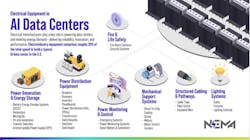
“What we’re seeing with microgrids: data centers need high uptime. They are willing to pay a premium to make sure power delivery is reliable, even more than what the grid can provide,” said Patrick Hughes, NEMA’s senior vice president of strategy, technical and industry affairs.
NEMA expects economy-wide electricity demand to increase 50% by 2050, with data center energy consumption jumping 300% between 2025 and 2035, Hughes said.
Data center operators are experiencing interconnection delays, and to circumvent those delays, they see onsite generation and microgrids, with the ability to take loads offline, as an opportunity to speed up project development and create resilience and reliability.“We expect to see more microgrids as grid constraints become more acute,” Hughes said. “You have to have microgrids at least for some data centers. Otherwise, the grid won’t be able to keep up and supply those. Data Centers need onsite generation and storage, integrating those through grid-connected microgrids is a fantastic way to have reliability.”
An October/November 2025 market survey of more than 150 distributed energy and microgrid professionals conducted by Energy Changemakers, Factor This Renewables and Xendee found that, in the face of federal funding cutbacks, interconnection delays and other challenges, developers are indeed turning to microgrids. They often begin off-grid to circumvent interconnection slowdowns and are also adding a number of different technologies, including solar, storage, combined heat and power (CHP), natural gas generators, fuel cells, wind, biogas, absorption chillers and hydrogen electrolyzers.
Microgrids can relieve grid stress from data center electric demand
Microgrids can help relieve some of the stress on the grid caused by data center development, especially in areas like northern Virginia, where data centers are clustered, Hughes said. They can island during peak demand periods, and deploying them will make it easier to build new data centers in areas where the grid is constrained.
Demand response programs are also expected to reduce grid stress. For example, a data center in Calgary has earned more than $400,000 since 2014 by participating in a demand response program. The facility lowered its grid energy consumption and utilized on-site systems, helping the grid during peak demand while maintaining uptime.
Energy storage also helps relieve grid stress. Microsoft replaced diesel backup generators at one of its data centers with a large battery system. This not only provides more than an hour of backup power, but also helps stabilize the grid and supports corporate clean energy goals.
How NEMA’s standards help microgrids serve data centers
One example of a NEMA standard: NEMA US 80056-2024 provides the performance requirements and testing procedures that ensure a microgrid control system can actually do what data centers need it to do, according to Hughes.
The standard focuses on microgrid control system performance capabilities, including but not limited to transition management, optimal energy dispatch, load management and harmonics management. Each control system performance capability is accompanied by its definition, functional requirements and key performance indicators to evaluate its successful performance.
This helps data center operators ensure their microgrid control systems can reliably perform critical functions such as seamless islanding, load management and optimal energy dispatch, Hughes said. This allows data center operators to better support uninterrupted operations when the grid is down.
“By applying the standard's performance requirements and testing procedures, data center developers can verify that their microgrid controllers will maintain uptime while coordinating smoothly with the utility grid and on-site resources,” Hughes said.
Dale Crawford, executive director of the Steel Tube Institute, which provides resources for steel tube and pipe producers, said NEMA’s microgrid design considerations appropriately emphasize safety, interoperability and lifecycle planning.
“Data centers that are integrating microgrids must safely support more complex power flows, higher fault currents and ongoing system reconfiguration,” he said.
Specifying steel conduit can help ensure long-term system reliability and electrical continuity, he added.
Guide identifies benefits and challenges of deploying microgrids
NEMA’s microgrid guide identifies the benefits of deploying microgrids for data centers and aims to ensure data centers safely take advantage of those benefits.
“The successful implementation of a data center microgrid requires a comprehensive and multidisciplinary approach that considers the interdependencies among technical, operational, and regulatory domains,” the guide said. “Critical factors include system architecture, control strategies, interoperability standards, cybersecurity, reliability criteria and compliance with applicable utility interconnection and safety regulations.”
About the Author
 Lisa Cohn
Lisa Cohn
Contributing Editor
I focus on the West Coast and Midwest. Email me at [email protected]
I’ve been writing about energy for more than 20 years, and my stories have appeared in EnergyBiz, SNL Financial, Mother Earth News, Natural Home Magazine, Horizon Air Magazine, Oregon Business, Open Spaces, the Portland Tribune, The Oregonian, Renewable Energy World, Windpower Monthly and other publications. I’m also a former stringer for the Platts/McGraw-Hill energy publications. I began my career covering energy and environment for The Cape Cod Times, where Elisa Wood also was a reporter. I’ve received numerous writing awards from national, regional and local organizations, including Pacific Northwest Writers Association, Willamette Writers, Associated Oregon Industries, and the Voice of Youth Advocates. I first became interested in energy as a student at Wesleyan University, Middletown, Connecticut, where I helped design and build a solar house.
Twitter: @LisaECohn
Linkedin: LisaEllenCohn
Facebook: Energy Efficiency Markets