Cummins Supplying Gas-Fired Generation Behind the Meter for West Texas AI Factory

On-site power technology firm Cummins Inc. will provide natural gas-fired generation for a behind-the-meter and microgrid combination electrifying a future supercomputing data center in Texas.
Digital infrastructure developer Circe Energy is contracting Cummins to deliver gas-fired generator sets including its HSK78 (C2000N6CD) and QSK60 (C1400N6) generator set platforms. Circe is creating an artificial intelligence-enabled data center campus in west Texas that will use the Cummins generators and engines.
Going behind the meter
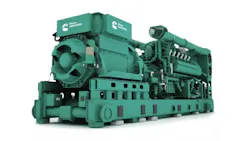
The developer has chosen to build out its power supply “behind the meter” or initially bypass the utility grid interconnection process. In this microgrid setting the natural gas-fired sets will provide primary power without initial reliability on the grid.
Data center and AI factory developers, microgrid integrators and even grid system operators are warning that coming demand from digital infrastructure is outpacing both generation and transmission system abilities to meet the load. This is leading more hyperscalers and data center developers to seek behind-the-meter solutions.
“Data center customers are navigating a new power reality where speed, reliability, and availability are just as critical as capacity—and downtime is not an option,” said Susan Cleaver, executive director of Cummins global power generation business, in a statement. “Cummins natural gas power solutions help customers meet unprecedented growth in data demand while closing utility power gaps with dependable on-site generation for large, power-intensive facilities.”
Meanwhile, U.S. natural gas production has been at historic highs for the past few decades. Natural gas engines can provide baseload and flexible power ramping up and down to deal with data center loads.
Cummins will provide natural gas generation, support Circe’s microgrid architecture, system controls and AI/high-performance computing-focused microgrid design. AI data centers consume more energy and produce more heat than traditional computing sites and generate transient loads which fluctuate dramatically in real time.
Circe Energy hopes to begin energizing its west Texas campus beginning in 2027. The facilities are designed to handle high-density AI compute speeds, liquid cooling and scalability. It is located on about 1,950 acres in the Permian Basin region.
“AI infrastructure depends on both power availability and delivery timing,” said Dagan Baroco, Chief Commercial Officer of Circe Energy. “Securing prime power natural gas generation solutions from Cummins, combined with our microgrid architecture and powered shell design, enables Circe to deliver scalable AI campus infrastructure on a predictable timeline while providing customers with a reliable and cost-competitive alternative to traditional grid-dependent development.”
AI factories are not data warehouses but more like manufacturing

To illustrate the difference between traditional data centers and AI super computations, NVIDIA’s Rev Lebaredian, who leads the chip giant’s Omniverse and Simulation Technology work, highlighted the leaps in both power and speed necessary for AI tasks at last year’s RE+ Conference in Las Vegas.
A data center is essentially a warehouse or storehouse, which can be accessed with relatively minor computing power, Lebaredian noted. An AI factory is more like a power-hungry manufacturing and refining center where all of that data is intensively distilled into something useful on a massive scale, such as gaining incredible insights into healthcare or industrial processing or facility operations and maintenance, so far beyond writing an easier school report that it becomes quaint to think of AI that way.
“You put into a factory all the raw materials and energy, and all the raw materials are reconfigured into it and out comes a refined production that is better than all of its parts,” he said at RE+. “With the factory you want to maximize the density as much as possible.”
Research firms and forecasters such as McKinsey & Co, JLL and Electric Power Research Institute are predicting that AI and data center load could double or even triple by the 2030s. At the same time, grid operators such as PJM Interconnection are warning that grid load is outpacing new generation installation to match it.
About the Author
 Rod Walton, Microgrid Knowledge Managing Editor
Rod Walton, Microgrid Knowledge Managing Editor
Managing Editor
For Microgrid Knowledge editorial inquiries, please contact Managing Editor Rod Walton at [email protected].
I’ve spent the last 18 years covering the energy industry as a newspaper and trade journalist. I was an energy writer and business editor at the Tulsa World before moving to business-to-business media at PennWell Publishing, which later became Clarion Events, where I covered the electric power industry. I joined Endeavor Business Media in November 2021 to help launch EnergyTech, one of the company’s newest media brands. I joined Microgrid Knowledge in July 2023.
I earned my Bachelors degree in journalism from the University of Oklahoma. My career stops include the Moore American, Bartlesville Examiner-Enterprise, Wagoner Tribune and Tulsa World, all in Oklahoma . I have been married to Laura for the past 36-plus years and we have four children and one adorable granddaughter. We want the energy transition to make their lives better in the future.
Microgrid Knowledge and EnergyTech are focused on the mission critical and large-scale energy users and their sustainability and resiliency goals. These include the commercial and industrial sectors, as well as the military, universities, data centers and microgrids. The C&I sectors together account for close to 30 percent of greenhouse gas emissions in the U.S.
Many large-scale energy users such as Fortune 500 companies, and mission-critical users such as military bases, universities, healthcare facilities, public safety and data centers, shifting their energy priorities to reach net-zero carbon goals within the coming decades. These include plans for renewable energy power purchase agreements, but also on-site resiliency projects such as microgrids, combined heat and power, rooftop solar, energy storage, digitalization and building efficiency upgrades.