With Bidirectional EVs, Solar and Storage, Critical California Bridge Can Stay Open During Outages

The San Francisco-Oakland Bay Bridge–which connects San Francisco to Oakland–is a critical escape route during disasters, but if the grid goes down, it has to close.
Without electricity, the California Department of Transportation (CALTRANS) can’t communicate with crews or monitor operations.
In a $5.3 million project that received a $3 million grant from the California Energy Commission (CEC) and $2.3 million in matching funds, a microgrid consisting of 51 kW of solar, a 60-KWh battery plus two heavy-duty bidirectional electric vehicles (EV) will keep the bridge open during outages.
The project tests vehicle-to-building technology’s ability to provide resilience to CALTRANS’ Oakland facility, which manages the bridge. In addition to CALTRANS, partners in the project include vehicle-to-everything provider Nuvve Holdings, the University of California Davis Energy and Efficiency Institute and Green Technology Laboratory, along with the West Oakland Environmental Indicators Project.
Disasters could cut off evacuation routes if no resilience available
“During a disaster, CALTRANS couldn’t support the bridge and would need to close it, which would impact evacuation routes,” said Hamza Lemsaddek, COO at Fermata Energy, which was recently purchased by Nuvve Holdings and offers a vehicle-to-everything platform for managing bidirectional EVs.
Bidirectional charging, which holds the promise of converting electric vehicles (EV) into mobile microgrids that can serve as backup resources, income-generating opportunities and grid assets, is seen as critical to the clean energy transition.
Now, with an increasing number of partnerships forming between EV sellers, bidirectional charging companies and utilities to study bidirectional charging technology, the promise is moving closer to reality.
Especially in California, bidirectional EVs are being tested to help serve up resilience in communities. For example, Schatz Energy Research Center researchers, along with Pacific Gas & Electric and Fermata Energy, have demonstrated how to use EV chargers in a microgrid at the Redwood Coast Airport to control solar overgeneration, boost resilience and support the main grid.
A separate project tests bidirectional school buses
In addition to the Oakland project, Nuvve has received $1.9 million from the California Energy Commission (CEC) under the CEC's Electric School Bus Bi-Directional Infrastructure funding program.
The grant will fund Nuvve's Resilient Energy Solutions for Schools (RESCHOOL) project, which aims to demonstrate the potential of bidirectional electric school buses to boost the resilience of California's power grid. RESCHOOL’s goal is to create a scalable model that would help other California school districts deploy their own zero-emission, bidirectional infrastructure.
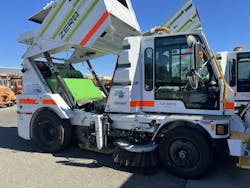
In the Oakland project, heavy-duty street sweepers will help provide backup power during emergencies. They were chosen because they have a predictable street-sweeping schedule, so it’s clear when their batteries will be available to help with resilience, Lemsaddek said. The partners are also looking at using bidirectional pickup trucks.
When the EVs are charging, the stand-alone batteries–charged with solar when it’s available–can provide resilience, especially when the EVs are being moved around–to go to another location and charge, for example.
EVs serve as storage on wheels
“During a long-duration outage, we can take vehicles out of the site, charge somewhere else and bring them back,” Lemsaddek said. “It’s storage on wheels.”
The project will use energy in the EVs and batteries to optimize energy costs–buying power from the grid when it’s cheap and discharging to the grid when power is expensive during peak hours–to generate revenue or offset the costs of grid power. The EVs and batteries will also participate in California’s Emergency Load Reduction Program.
The partners in the project are testing the microgrid's ability to island and operate the emergency operations center, allowing the California Highway Patrol and CALTRANS to respond to disasters, he said.
When in island mode, the microgrid will back up critical systems, including lighting and communications equipment powering radios and other devices.
Oakland project uses more common type of EV charger
Unlike the airport example–which uses Fermata’s Chademo bidirectional chargers and Nissan Leaf EVs–the chargers in the Oakland project are Nuvve combined charging system (CCS) technology, which combines AC and high-power DC fast charging into a single connector. CCS technology is more common than the Chademo technology.
In addition to providing resilience, the Oakland microgrid will demonstrate how to reduce reliance on diesel-powered backup generators.
Ultimately, the project partners hope to scale the vehicle-to-building technology in California and other areas, deploying it in “every building” that now uses diesel as backup, Lemsaddek said.
The project will yield numerous societal benefits, both when the grid is up and running–called Blue Sky operations–and during power outages.
“Under Blue Sky operations, we will manage energy to reduce the overall cost by tapping into batteries on wheels and stationary storage to lower energy costs and support the grid,” he said. “We are reducing costs to customers when the grid is up and providing resilience and backup when the grid is down.”
About the Author
 Lisa Cohn
Lisa Cohn
Contributing Editor
I focus on the West Coast and Midwest. Email me at [email protected]
I’ve been writing about energy for more than 20 years, and my stories have appeared in EnergyBiz, SNL Financial, Mother Earth News, Natural Home Magazine, Horizon Air Magazine, Oregon Business, Open Spaces, the Portland Tribune, The Oregonian, Renewable Energy World, Windpower Monthly and other publications. I’m also a former stringer for the Platts/McGraw-Hill energy publications. I began my career covering energy and environment for The Cape Cod Times, where Elisa Wood also was a reporter. I’ve received numerous writing awards from national, regional and local organizations, including Pacific Northwest Writers Association, Willamette Writers, Associated Oregon Industries, and the Voice of Youth Advocates. I first became interested in energy as a student at Wesleyan University, Middletown, Connecticut, where I helped design and build a solar house.
Twitter: @LisaECohn
Linkedin: LisaEllenCohn
Facebook: Energy Efficiency Markets