Empowering Communities to Decide How and Where to Deploy Community Microgrids–the Oregon Way

Oregon’s HB 2065 and HB 2066 created a novel approach to building resilience by letting communities decide how and where to create community microgrids funded by ratepayers located inside microgrid zones.
The panelists who participated in a Nov. 12 teleconference, “Community Microgrids and the Market Shift Behind Oregon’s AR 681,” organized by Mayfield Renewables, an engineering consultant, provided details about the new roles of engineers, developers, governments and utilities under the laws.
Creating a framework for owning and deploying community microgrids
The Oregon laws aim to develop a framework for ownership, deployment and use of community microgrids in Oregon by March 26, 2027, and stakeholders are now working on that task. The effort has garnered much attention in the Northwest and nationally in part because communities nationwide are grappling with natural disasters, wildfires and flooding, said M. Alex Clingman, clean energy program manager at Sustainable Northwest, a nonprofit that promotes clean energy.
For example, Oregon faced a record-breaking wildfire season in the summer of 2026. What’s more, the state is a hotspot for data centers, which are increasingly turning to microgrids to power their facilities.
“These bills are about allowing communities to lead the conversation,” said Kevin Wright, president at ProtoGen, which provides project development. “The communities get to make the decision and define what’s important.”
The laws change the relationship between utility customers, utilities and engineers.
In microgrid zones, developers can use existing energy infrastructure
Under the laws, communities can create a microgrid zone and use existing energy infrastructure, Wright said during the conference.
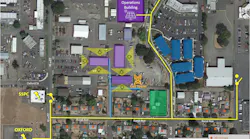
“It could be a fairgrounds, the downtown or a whole city. Local government defines it,” he said. “Anything within the zone can be fair play for a community microgrid." That might include a community solar array or a small hydroelectric plant that’s already been built and funded.
Participants in a community microgrid can share costs within their microgrid zone, with the approval of the Oregon Public Utility Commission, Wright said during an interview. Cost recovery can cover the shared design, construction and maintenance of the community microgrid for customer use.
A microgrid driven by a community that encompasses multiple buildings would be rate-based within the microgrid, and rates would include the value of energy resilience, said Miller in an interview. Working groups are now contemplating how to define resilience, he said.
In addition, AR681 creates a new, second interconnection pathway. Traditionally, utilities led the interconnection study process, but now they are legally obligated to support third parties in that effort, Miller said.
That means they will have to share data–load data and transformer types, for example. Mayfield Renewables could start offering in-house interconnection studies using utility data under the new microgrid framework.
“The goal is to reduce administrative friction and speed up the interconnection process,” Wright said.
For communities, getting this information up front–before they attempt to connect to utilities–saves time and money.
The role of utilities in microgrid projects changes in other ways under the laws, Wright said.
A different role for utilities
Utilities will continue to be responsible for the safe and reliable operation of the distribution network. If a project meets this requirement, the utility serves as a technical collaborator. Its wires and meters are central to a community microgrid under the proposed rules. That means the utility must make them available for use as part of the microgrid. But the utility continues to own and operate the wires and meters, Wright said.
Utilities also must buy excess generation from the microgrids.
City and county governments play an important role under the new laws. “They can lead planning for the use of utility distribution assets within their jurisdictional limits,” Wright said.
A business opportunity: microgrid operator
The laws also create a microgrid operator role that creates a significant business opportunity, Wright said. This is similar to a virtual power plant aggregator in other states. The microgrid operator represents the interests of the microgrid or community microgrid.
The organization coordinates with the local utility to operate front-of-meter generation that the utility does not own, including existing community solar, along with behind-the-meter distributed energy resources. One operator can represent a portfolio of microgrids and the operator will not operate utility infrastructure.
Creating these new roles is critical to deploying more community microgrids under the new laws, Wright said.
“We spent a lot of time defining new roles,” he said during the conference. “That’s one thing we’ve done right in Oregon.”
About the Author
 Lisa Cohn
Contributing Editor
I focus on the West Coast and Midwest. Email me at [email protected]
I’ve been writing about energy for more than 20 years, and my stories have appeared in EnergyBiz, SNL Financial, Mother Earth News, Natural Home Magazine, Horizon Air Magazine, Oregon Business, Open Spaces, the Portland Tribune, The Oregonian, Renewable Energy World, Windpower Monthly and other publications. I’m also a former stringer for the Platts/McGraw-Hill energy publications. I began my career covering energy and environment for The Cape Cod Times, where Elisa Wood also was a reporter. I’ve received numerous writing awards from national, regional and local organizations, including Pacific Northwest Writers Association, Willamette Writers, Associated Oregon Industries, and the Voice of Youth Advocates. I first became interested in energy as a student at Wesleyan University, Middletown, Connecticut, where I helped design and build a solar house.
Twitter: @LisaECohn
Linkedin: LisaEllenCohn
Facebook: Energy Efficiency Markets