Potable Water and Refrigeration To be Added to Gentilly “Microgrid Beehive,” Deployed in New Orleans After Hurricane Ida
After Hurricane Ida hit New Orleans in 2021, the city lost 19 community members to heat exposure while the power was out, and Groundwork New Orleans, partnering with Footprint Project, started investigating ways to provide microgrid resilience.
At the time, the nonprofit Footprint Project–which equips areas hit by disasters with clean energy–was developing the microgrid beehive idea, said Todd Reynolds, executive director at Groundwork New Orleans, which focuses on creating green and resilient neighborhoods, along with developing an environmental youth workforce.
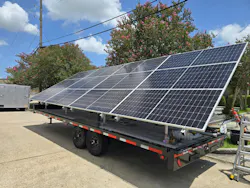
A microgrid beehive, trademarked by Footprint Project, is made up of stationary microgrids that serve as the hive. A group of portable microgrids—known as the “bees”--can charge or discharge energy at the beehive and then travel where they’re needed. The stationary microgrids have a permanent location, and the “bees” can be stationed at the beehive until they’re needed in the surrounding community.
As part of the microgrid beehives, the organizations often loan out “pollinators,” which are solar batteries in a metal cabinet that also includes inverters and a charge controller, Reynolds said.
Beehive Deployed in Gentilly Neighborhood of New Orleans
In 2023, the organizations installed one of the first microgrid beehives at the NET Charter High School in the Gentilly neighborhood of New Orleans, where Reynolds had previously served as principal. The Gentilly neighborhood is a large, historically residential and disadvantaged neighborhood located in central New Orleans, where mobile “bee” trailers could easily be dispatched to neighborhoods that needed resilience during power outages, he said.
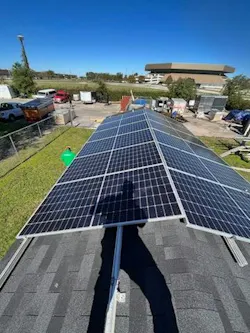
The school project included a semi-permanent “Queen Bee” unit, a 30-foot-long off-grid trailer that will remain at the school. It has 15 kW of solar and 55.5 kWh of storage. A bee trailer was also deployed.
The Queen Bee microgrid powers the school’s outdoor classrooms and Groundwork New Orleans’ office on the school grounds. The mobile unit has also powered community events.
Two new trailers are expected to be added to the project. One trailer will be a solar-powered refrigeration freezer trailer that will allow people to store their medicine and food, Reynolds said.
The other unit will include atmospheric water generation technology, allowing the organization to produce potable water during outages when water pumps go down or when water infrastructure isn’t available. It will produce about 200 gallons of water a day. Plans also call for Groundwork New Orleans to add a larger unit to the school site that can produce 600 gallons a day, he said.
Beehive deployed as alternative to roof-mounted solar panels
The project has yielded many benefits, including helping train young people in solar.
“Under my workforce development program, we worked with Footprint Project and my young folks actually built a solar bee while learning solar, learning the concepts, learning construction,” Reynolds said.
The microgrid hive and bees have had one opportunity to help out during an emergency. In 2022, a tornado hit New Orleans, knocking out power, and Groundwork New Orleans and Footprint Project deployed the microgrid and mobile units for charging and backup power.
While power was out, Groundwork New Orleans loaned out the “pollinators” — or battery kits — to people who could use them to charge phones and other items, Reynolds said.
Funding sources include the U.S. Environmental Protection Agency
A $500,000 grant from the U.S. Environmental Protection Agency’s Justice Collaborative Problem Solving Cooperative helped pay for the project, which initially called for six bees, Reynolds said. In February 2025, the Trump administration issued a termination notice and the project team scaled back the design to two bees.
In 2022, the project received $7,500 through Clean Energy Group’s Technical Assistance Fund for a feasibility assessment.
The microgrid project also received funding from multiple organizations, and Schneider Electric donated materials and design assistance.
“It was a great combination of groups coming together to get this grid operational,” Reynolds said.
Microgrid beehives deployed to disaster areas
In addition to completing the Gentilly beehive in 2023, Footprint Project has deployed numerous microgrid beehives to disaster areas, including for desperate Texans during the state’s February 2021 deep freeze and other crises. It also came to the rescue in Ukraine when the war with Russia broke out in February 2022.
Plans now call for connecting the Gentilly microgrid to the grid.
“The goal is now to create a bypass to tap into the school system so that when the power goes out, we can just switch it and it'll power their essential services,” Reynolds explained.
Reynolds hopes that the new projects will be funded by grants, and is taking an unconventional approach to funding.
“I don't wait till we get 100% of the funding. I receive X amount to do X amount of a phase,” Reynolds said. “What happens in that scenario is as you start building and as you start doing, you're able to attract more interest in your project instead of this conceptual thing that you're asking people to support.”
About the Author
 Lisa Cohn
Contributing Editor
I focus on the West Coast and Midwest. Email me at [email protected]
I’ve been writing about energy for more than 20 years, and my stories have appeared in EnergyBiz, SNL Financial, Mother Earth News, Natural Home Magazine, Horizon Air Magazine, Oregon Business, Open Spaces, the Portland Tribune, The Oregonian, Renewable Energy World, Windpower Monthly and other publications. I’m also a former stringer for the Platts/McGraw-Hill energy publications. I began my career covering energy and environment for The Cape Cod Times, where Elisa Wood also was a reporter. I’ve received numerous writing awards from national, regional and local organizations, including Pacific Northwest Writers Association, Willamette Writers, Associated Oregon Industries, and the Voice of Youth Advocates. I first became interested in energy as a student at Wesleyan University, Middletown, Connecticut, where I helped design and build a solar house.
Twitter: @LisaECohn
Linkedin: LisaEllenCohn
Facebook: Energy Efficiency Markets
Related
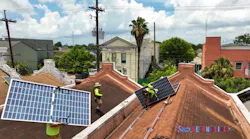
 Will Heegaard, Footprint Project, left, and Cade Spencer, Renewable Design Associates, installing a POP-UP EMERGENCY CRITICAL SERVICES MICROGRID at CooperRiis Mental Health Halfway house for lights and refrigerators on day three of the Helene recovery