Can Bidirectional Charging Help Budget-Strapped School Districts Pay for Fleet Electrification?
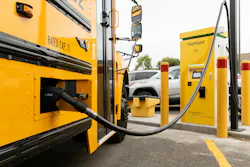
Electric school bus adoption in the U.S. has progressed at a snail’s pace — just 2.9% of the nation’s fleet of nearly 500,000 school buses are electric. So, when Jefferson County (Jeffco) Public Schools and Highland Electric Fleets, an Electrification-as-a-Service provider, recently announced the launch of six electric school buses, it was notable.
But it turns out that the real story here isn’t the buses themselves, it’s the bidirectional chargers installed at the district’s Lakewood, Colorado, transportation facility.
Why? Because bidirectional chargers are rewriting the math on school transportation modernization.
"Electric school buses can deliver meaningful benefits for students and the communities they serve," Brian Buccella, chief commercial officer of Highland Electric Fleets, said in a statement. "Replacing just five diesel buses with electric school buses can reduce pediatric asthma risk for 1,500 students.”
Yet for many school districts, investing in electric buses and the requisite charging infrastructure is something their cash-strapped capital budgets simply can’t bear.
The buses alone are nearly twice the price of diesel models. Maintenance and operational costs are considerably lower for electric buses (especially with diesel averaging $6.34 a gallon), but even with the savings, a lot of districts still can’t make the math work.
Or rather, they can’t make the math work when the bus battery only powers the bus.
With a bidirectional charger, the battery can send excess power to the grid, turning the vehicle into a mobile energy asset that can support the grid during peak demand.
That completely changes the financial picture, Mike Calise, CEO of Tellus Power, told Microgrid Knowledge in an exclusive interview. Tellus Power builds bidirectional EV charging solutions similar to the one installed in Colorado.
“These dispatchable energy resources can be sold back to the grid, and during grid events [utilities will pay] 10 times or 20 times” the usual rate for the power, Calise explained, adding that with this approach the system can pay for itself often within two years.
For many school districts, the additional income from providing such vehicle-to-grid (V2G) services can make electrification a viable investment.
Oakland schools paved the way
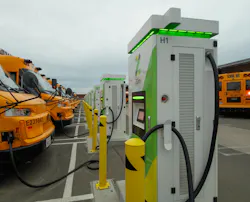
Electric school buses are uniquely suited to providing V2G services because they spend most of the school day parked at the depot. They charge overnight during off-peak hours, make their morning and afternoon runs, and are back at the depot in time to discharge power during peak demand events.
One of the first bidirectional school bus charging installations was completed in 2024 for the Oakland (California) Unified School District.
Tellus Power worked with student transportation provider Zum (pronounced Zoom) on the project, which includes 74 electric school buses, each with a 150-kWh battery, and an equal number of bidirectional charging stations.
In Oakland, the buses typically return to the depot with roughly 80-90% charge. They can be topped off before peak demand events, then discharged down to about 20%, making up to 80% of their battery capacity available to the grid, typically between 4 and 8 p.m.
“They constitute around 2.5 to 2.7 MW on any given day,” enough to power around 1,000 homes, Srikanth Kanaparthi, chief technology officer at Tellus Power, told Microgrid Knowledge.
On weekends and school breaks, when the buses aren’t shuttling students to and from school, their batteries are fully available to support the grid. Charging and discharging the batteries happens automatically. “The chargers are programmed to operate without any human intervention. You plug it in the connector and leave it,” Kanaparthi said.
Utilities are on board with V2G
In an era where data centers and electrification are pressuring the grid like never before, V2G is something many utilities are getting behind.
PG&E was instrumental in getting the Oakland project connected to the grid, and Tellus Power is providing its American made bidirectional chargers to similar installations in Los Angeles, San Francisco and Branford, Connecticut.
In Colorado, Xcel Energy provided $3.4 million in funding for the Jefferson County Schools project through its Electric School Bus (ESB) Program. The utility aims to fund a total 38 school buses and 30 bidirectional chargers across Colorado to demonstrate the technology.
"Electric school buses are creating new opportunities for schools to modernize their fleets while supporting Colorado's broader energy future," Robert Kenney, president of Xcel Energy – Colorado, said in a statement. "Through our Electric School Bus Program, we're helping school districts like Jefferson County Public Schools invest in cleaner transportation today while gaining valuable experience with technologies that can strengthen and add flexibility to the grid in the years ahead."
Schooling data center demand
While V2G programs focus on delivering battery energy to the broader grid, Tellus Power’s Calise envisions a future where school buses, paired with a battery energy storage system, could directly support data center loads.
With a vehicle-to-everywhere approach, “you can turn what was a passive depot…into an energy asset for the grid when needed or to power AI data center loads,” he said. “It’s a winning combination.”