Wildan Group Designing $31M Biogas Microgrid to Power Encina Wastewater Plant
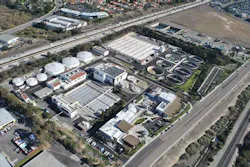
A Southern California wastewater utility is hiring design and engineering firm Willdan Group to build a renewable cogeneration microgrid project for one of its facilities.
Encina Wastewater Authority selected Wildan to lead the $31 million project that will create and use biogas generated from treatment to produce on-site electricity. The system will include a new biogas conditioning system, generators, emissions upgrades, and battery energy storage integrated with a microgrid controller.
“This project allows us to provide continuous service to the North San Diego County communities we serve, ensuring uninterrupted operations even during periods of constrained utility power or grid disruptions,” said Scott McClelland, General Manager of Encina, in a statement. “Our goal is to significantly reduce emissions for permit compliance, allowing us to utilize all of our renewable biogas resources to generate power for 100% of our current electrical needs.”
Encina Wastewater Authority, which is based in Carlsbad, provides public wastewater treatment services to about 380,000 residents in northwestern San Diego County. It is owned by the cities of Carlsbad, Vista, Encinitas, Vallecitos Water District, Buena Sanitation District and the Leucadia Wastewater District.
Using biogas to generate electricity produces greenhouse gas emissions, but compared to natural gas or diesel it captures and reduces methane emissions which are considered multiple times more damaging to the atmosphere than carbon dioxide (CO2), according to many environmental scientists. The “closed loop” system may only emit the CO2 which already was embedded within the waste product.
Microgrids for Water and Wastewater Infrastructure
Read our Full Coverage
“Many public agencies are looking for solutions that can bolster critical infrastructure while improving sustainability,” said Mike Bieber, Willdan’s CEO. “We appreciate this opportunity to create a solution for Encina that adds long-term value and energy resiliency to their operations.”
Willdan Group has designed and built distributed energy and microgrid projects for numerous public customers, including higher education facilities. Earlier this year, California’s Mt. San Antonio College selected Willdan for a $49 million contract to install solar, battery energy storage and EV charging stations connected within the microgrid.
Nationwide, other wastewater infrastructure entities which have chosen microgrid solutions include DC Water in Washington, Rialto, California; North Fork Bend Water Authority in Texas, and Monterrey One Water in California.
About the Author
 Rod Walton, Microgrid Knowledge Managing Editor
Rod Walton, Microgrid Knowledge Managing Editor
Managing Editor
For Microgrid Knowledge editorial inquiries, please contact Managing Editor Rod Walton at [email protected].
I’ve spent the last 18 years covering the energy industry as a newspaper and trade journalist. I was an energy writer and business editor at the Tulsa World before moving to business-to-business media at PennWell Publishing, which later became Clarion Events, where I covered the electric power industry. I joined Endeavor Business Media in November 2021 to help launch EnergyTech, one of the company’s newest media brands. I joined Microgrid Knowledge in July 2023.
I earned my Bachelors degree in journalism from the University of Oklahoma. My career stops include the Moore American, Bartlesville Examiner-Enterprise, Wagoner Tribune and Tulsa World, all in Oklahoma . I have been married to Laura for the past 36-plus years and we have four children and one adorable granddaughter. We want the energy transition to make their lives better in the future.
Microgrid Knowledge and EnergyTech are focused on the mission critical and large-scale energy users and their sustainability and resiliency goals. These include the commercial and industrial sectors, as well as the military, universities, data centers and microgrids. The C&I sectors together account for close to 30 percent of greenhouse gas emissions in the U.S.
Many large-scale energy users such as Fortune 500 companies, and mission-critical users such as military bases, universities, healthcare facilities, public safety and data centers, shifting their energy priorities to reach net-zero carbon goals within the coming decades. These include plans for renewable energy power purchase agreements, but also on-site resiliency projects such as microgrids, combined heat and power, rooftop solar, energy storage, digitalization and building efficiency upgrades.