Acai Energy: New Renewable Minigrid Powers Brazilian “Superfood” Facility

A new solar and energy storage minigrid is breathing life into an açaí processing facility in Bela Conquista, a remote river-side community in the Amazon. Located in the Catuá-Ipixuna Extractive Reserve in northwestern Brazil, the installation includes a 50-kW-peak solar array and a 165-kWh battery storage system.
Minigrids, sometimes referred to as remote microgrids, are typically built and operated in areas without access to a central electric grid. The systems use software to control distributed renewable energy resources like solar panels and battery storage, providing remote communities with reliable, clean and affordable power.
The technology has been widely adopted across Africa, bringing reliable power to remove communities in Zambia, Ethiopia and Nigeria.
A superfood and an economic driver
Açaí, grown on the Açaí palm tree in Central and South America, is regarded as a superfood thanks to its high levels of antioxidants and other properties that support heart health, brain function and healthy skin and hair.
The purple berry has been a top global health trend in recent years, particularly when consumed as the base of an açaí bowl, a thick smoothie-like concoction often topped with fresh fruit, granola and nuts.
That makes it incredibly valuable to the often indigenous communities that harvest and process the fruit.
The U.S. Department of Agriculture estimates Brazil alone will produce more than 2 million metric tons of the berry this year, and industry analysts value the global market more than $1.6 billion.
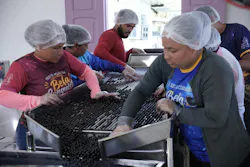
First envisioned in 2017, the Bela Conquista processing facility struggled with unreliable power from a diesel-based electric system.
"The biggest bottleneck we faced in getting the business to operate was the lack of reliable energy,” Daniel Gama, a resident of Bela Conquista and president of the processing facility project, said in a statement. “We had many problems with the existing grid because of the conditions of the distribution line, and the electricity reaching the facility was not sufficient to power all the machines."
The microgrid is a game changer, enabling the facility to process 36,000 liters of açaí fruit each year.
It’s also a prime example of how sustainability can positively impact the people and the rainforest, which is considered by many to be the front line of the climate crisis.
"Our hope is that people will reduce deforestation for planting and farming and that we can increasingly rely on extractive activities, taking from the forest what it already offers us,” Luzia Pinto, a community matriarch, said in a statement from Global Energy Alliance for People and Planet (GEA), one of the developers behind the project. “We have Brazil nuts here, as well as açaí, which is our main product today. We can harvest from nature without deforesting and without harming our forest,"
Empowering remote communities with reliable power
The minigrid is also helping to power critical infrastructure, including the school, community center and kitchen and the community water well.
Of the nearly one million Brazilians without access to reliable electricity, 95% live in the Amazon rain forest. An additional two million Amazonians rely on polluting diesel, which is expensive and is highly unreliable thanks in part to fuel delivery logistics.
The Bela Conquista minigrid is the first of 20 pilot projects expected to be launched by 2029 by GEA, the Foundation for Amazon Sustainability (FAS) and Brazil's Ministry of Mines and Energy. The minigrids aim to show how reliable electricity can support economic growth and development across the Amazon.
The initiative is expected to reach 25 communities and support a variety of agricultural endeavors, including fishing and fruit processing.
Global Energy Alliance said in a statement the solar and battery minigrids will generate up to 1 GWh of solar power annually and avoid 255,000 liters of diesel and 680 tons of carbon dioxide.
GEA and FAS will also provide training to community members so that ownership, operations and maintenance of the minigrids remain with the community.
"This is a remarkable project in which we intend to use energy as a driver of prosperity, creating the conditions for communities to remain in the territories where they have chosen to live, with quality of life and opportunities to generate income, while also contributing to the conservation of the Amazon rainforest, an asset of fundamental importance to the entire world," Luisa Valentim, Brazil Delivery Lead at Global Energy Alliance, said in a statement.
About the Author
 Kathy Hitchens
Kathy Hitchens
Special Projects Editor
I am a writer and special projects editor for Microgrid Knowledge. I have over 30 years of experience covering the renewable energy, electric vehicle, utility, technology, entertainment, education, and financial sectors. I have a BFA in Media Arts from the University of Arizona and a MBA from the University of Denver.