AC/DC: Will Duke Energy’s Tiny Home Nanogrid Rock the Future?
Tiny homes are all the rage these days. From retirees looking to downsize, to first-time homebuyers trying to break into a tough housing market and everyone in between, living small is appealing to some 73% of Americans for both economic and sustainability reasons.
It turns out that tiny homes may also be the perfect platform to test and showcase new ways of consuming electricity.
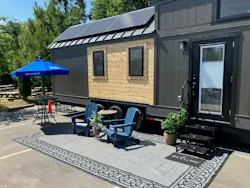
Duke Energy recently launched a tiny home nanogrid research platform to showcase how integrating direct-current (DC) power into a home can be beneficial to consumers and the grid.
A nanogrid is essentially a smaller version of a microgrid. It is a self-contained electric power generation system that can operate independently from the power grid.
In this case, the 289-square foot tiny home’s nanogrid runs two electrical systems in parallel.
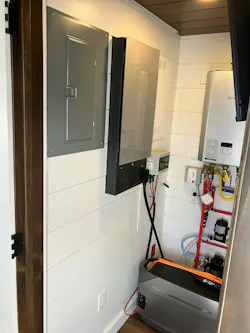
There’s a DC system that’s powered by 3 solar panels generating 1.3 kW of power and 4 kWh battery. It runs basically everything in the home that’s above your head or eye level – LED lighting, a ceiling fan and even the television.
Everything else — including the major appliances like the refrigerator and microwave — is powered by the alternating current (AC) from the grid.
Other than a charger that enables the battery to be replenished by grid power when solar production is low, the two systems do not intermingle.
To accommodate the two systems, the team installed three breaker panels. Because DC components are not commercially available, they had to design and 3-D print many of the panel’s parts, as well as the DC wall outlets.
Rethinking residential power
The AC versus DC argument dates back to the late 19th century when Nikola Tesla and Thomas Edison waged what’s been dubbed “The War of the Currents.” Numerous books have been written on the subject, but suffice it to say, Tesla’s alternating current scheme won out over direct current, which Edison favored.
Fast forward to the 21st century, and while the power grid feeds your home’s wall outlets with the alternating current that flows across the nation’s transmission and distribution lines, most of your electronic devices and many appliances actually run on DC. That means your cell phone chargers, laptops, televisions, LED lights, ceiling fans, garage door openers, and air conditioners all use a rectifier — a brick, wall wart or something built-in to the device — to convert AC to DC power.
That conversion comes at a cost — energy is lost in the form of heat.
Eliminating that loss is the goal of the Duke Energy demonstration project.
Accumulated savings add up

The monthly financial savings generated by the hybrid approach are admittedly small, according to Steve Hinkel, emerging technology applications director at Duke Energy, and the tiny house project lead, though he believes the larger the home, the greater the savings will be. That said, they do accumulate over the whole course of a year.
“It wouldn't make sense if we just had one or two devices. It's when you get into all your LED lighting, the fans — that's where you hit this critical tipping point where this [approach] does make sense.”
An all of the above approach
The choice to leverage both AC and DC power in the tiny home was intentional, as the team was looking for ways to use energy in the smartest, most affordable way possible.
Finding the right balance between efficiency and cost is the “secret sauce” of the project, Hinkel said.
“We’re not looking for electrical perfection. We’re balancing it with cost,” he explained, noting that they built the entire Nanogrid for just $4,000.
A fully DC-powered home simply didn’t pencil out, due in large part to the cost of DC-native appliances.
For example, they selected a $300 microwave found at your typical big box store.
“We could have bought one that was slightly more energy-efficient, that was direct current, but it was $3,000. That doesn’t make sense,” Hinkel said.
Likewise, they opted for a smaller battery that could power the DC side for up to three days, rather than investing in a more expensive option or buying additional solar panels. They found that pulling additional power from the grid “at $0.10 or $0.12 per kilowatt hour was way more cost effective,” he said.
A hybrid future?

The tiny home, which is mobile, was recently featured as part of the U.S. Department of Housing and Urban Development’s 2026 Innovative Housing Showcase. It will also make an appearance at the North Carolina State Fair, where it’s bound to draw a crowd. Microgrids and minigrids have featured prominently in the state’s recovery from Hurricane Helene.
There’s still testing to be done. Duke Energy wants to compare the hybrid nanogrid’s performance side-by-side with a fully grid connected model to see how the savings really stack up.
“Our goal is to get one free month of electric,” Hinkel said.
Jon Landy, emerging technology and operations director for Duke Energy, said the team is excited to learn how a hybrid architecture could expand beyond residential applications.
“A lot of our large load customers have a significant amount of DC load as well, so what kind of learnings could we take from this and apply to how we serve other customer classes?” he said.
The team also hopes the demonstration will support the development of direct current codes, standards and policies, which currently don’t exist.
For example, the black wire is “hot” in an AC system, but it’s the ground in DC. If an electrician’s doing a retrofit, “how do they know which is which? We need some standards around that just to ensure nobody gets hurt,” Hinkel said.
Likewise, there are well-established voltage standards for AC-powered devices (110v and 240v), but compatibility is a challenge in the DC world because voltage standards are all over the board.
From nanogrids to microgrids, DC is a hot topic
Several companies are exploring how all-DC microgrids can be used commercially. In Charlotte, Hyde Park Partners have operated a DC microgrid for over ten years, proving that such systems are viable for commercial use, reduce losses and enhance resilience.
Others, including the Current/OS Foundation, an organization funded by Schneider Electric and nearly 100 other industry players, believe DC microgrids at the grid edge could enable the integration of more renewables, reduce power demand and lower costs.
About the Author
 Kathy Hitchens
Kathy Hitchens
Special Projects Editor
I am a writer and special projects editor for Microgrid Knowledge. I have over 30 years of experience covering the renewable energy, electric vehicle, utility, technology, entertainment, education, and financial sectors. I have a BFA in Media Arts from the University of Arizona and a MBA from the University of Denver.