Blizzard of Weather and Aging Utility Infrastructure Inspires Plan for AI-Enabled Microgrid in Western New York
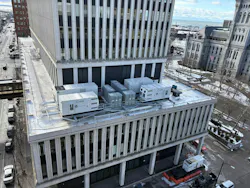
For the Erie County Department of Public Works–a 16-story building in western New York that is home to many of the county’s public agencies–high capacity charges, power outages from snowstorms and an aging utility infrastructure all called for a microgrid.
Capacity charges from the agency’s utility, National Grid, can be as high as 30% of its electricity bill.
The community experienced an outage after a devastating blizzard in December 2022 that also cut power to 20,000 utility customers and major facilities in Buffalo, some for 4 days. In addition, three substations failed due to snow and ice.
A 2-MW microgrid to be deployed
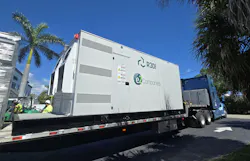
To help the county avoid future power issues during major storms, e2Companies will commission a 2-MW microgrid in the next six weeks or so, said James Richmond, co-owner, CEO and president at e2Companies. It will lower capacity charges, reduce utility costs and provide resilience and reliability, he said.
Erie County paid for the microgrid and will recoup the investment through lower costs, federal and state rebates. Along with achieving reliability and resilience, the county will avoid buying a new diesel backup generator to replace the rented generators the county uses during storms.
By avoiding diesel generators, Erie County won’t have to figure out how to fill a diesel tank–especially during a snowstorm. Most emergency diesel units have only 12 to 24 hours of fuel.
“They've eliminated that issue and can run the microgrid for weeks or months,” Richmond said.
A 40% investment tax credit helped pay for the microgrid
When it purchased the microgrid, Erie County was assured it would be eligible for up to 40% in federal investment tax credits. The project qualified for the credit because most components of the energy storage system and its infrastructure were manufactured in the U.S.
The microgrid is controlled by e2Companies’ R3Di system. Called a “virtual utility,” it’s a microgrid-in-a-box that can integrate many different types of energy resources and can be both grid-connected and off-grid. In this case, the unit will be fueled by natural gas, along with some solar.
Also included in the project will be 18 EV charging stations. e2Companies will eliminate peak charges by using the microgrid’s two batteries during peak hours.
Using the batteries to flatten the load and avoid demand and capacity charges is expected to improve efficiency for the Erie County facility by 35%, Richmond said.
Artificial intelligence monitors and predicts building load and grid conditions

The microgrid’s energy management system uses artificial intelligence (AI) to monitor and predict building load and grid conditions, and to adapt to weather conditions.
As a registered curtailment service provider, e2Companies gain access to information about grid conditions.
“We know the supply side. We know the equipment that's sitting on site, whether it's wind, solar or gas engines,” Richmond said. “We know the power profiles, what it can produce.”
The company also has access to weather forecasts, as well as hour-ahead, two-hour-ahead and week-ahead predictions of power needs.
AI uses that information to select from a number of different operating options, including the most efficient or reliable–whichever is needed at the time. For example, at night, efficiency may not be as important because the load is low, Richmond said.
How the microgrid flattens the load
But during the day, when load and utility prices are high, the system uses its batteries to provide power and reduce grid demand.
That’s how the system lowers or avoids capacity charges. It flattens the building’s load profile and eliminates demand spikes, Richmond said.
With this system, e2 designs for average load rather than peak load, reducing the microgrid's size. With its batteries and inverter, the system can temporarily provide power during peak conditions, reducing equipment needs and lowering up-front costs.
The Erie County Department of Public Works will be able to participate in grid services programs, including voltage frequency regulation and load curtailment, Richmond said.
Bring on the Buffalo blizzards
The Erie County Department of Public Works’ microgrid means the county will be prepared for the next big blizzard, avoiding outages and allowing the department to continue managing and maintaining roads and bridges. It will also help the department meet sustainability goals for its facilities in western New York.
“The microgrid is an upgrade that helps the county avoid being dependent on the old utility infrastructure,” Richmond said.
About the Author
 Lisa Cohn
Lisa Cohn
Contributing Editor
I focus on the West Coast and Midwest. Email me at [email protected]
I’ve been writing about energy for more than 20 years, and my stories have appeared in EnergyBiz, SNL Financial, Mother Earth News, Natural Home Magazine, Horizon Air Magazine, Oregon Business, Open Spaces, the Portland Tribune, The Oregonian, Renewable Energy World, Windpower Monthly and other publications. I’m also a former stringer for the Platts/McGraw-Hill energy publications. I began my career covering energy and environment for The Cape Cod Times, where Elisa Wood also was a reporter. I’ve received numerous writing awards from national, regional and local organizations, including Pacific Northwest Writers Association, Willamette Writers, Associated Oregon Industries, and the Voice of Youth Advocates. I first became interested in energy as a student at Wesleyan University, Middletown, Connecticut, where I helped design and build a solar house.
Twitter: @LisaECohn
Linkedin: LisaEllenCohn
Facebook: Energy Efficiency Markets