How EV Owners Can Reap Income When Their Cars Serve as Mobile Microgrids
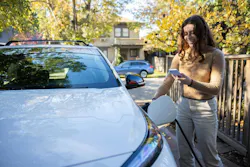
Bidirectional electric vehicles (EV) are seen as key to shoring up the grid by storing and delivering energy via vehicle-to-grid (V2G) programs.
This was once a wild idea, but it’s coming to fruition and beginning to deliver income to EV drivers through several new pilot projects that take advantage of incentives such as California’s Emergency Load Reduction Program and New England’s ConnectedSolutions program.
For example, Pacific Gas & Electric (PG&E) has rolled out three pilot programs that use bidirectional EVs to absorb energy into their batteries when it’s less expensive, then release it to the grid, office building or home when rates are high, lowering energy costs and supporting the grid when it’s strained.
Under PG&E’s residential vehicle-to-everything program, customers receive upfront incentives and must enroll in the Emergency Load Reduction Program, under which they are eligible to receive additional incentives.
National Grid, Eversource Plug EVs into existing incentive programs
On July 23, National Grid and Eversource unveiled a program that opens up additional avenues for residential EV owners to earn money. They are working with Sunrun, EnergyHub and The Mobility House.
Drivers can enroll EVs equipped for V2G in ConnectedSolutions, which until now has focused on acquiring flexible capacity from thermostats, batteries and industrial resources to shore up the grid.
One of the goals of the new program is to test whether EVs can help reduce costs for all Eversource and National Grid customers by sending energy from EV batteries to the grid during peak demand periods.
“The Massachusetts pilot has an advantage of being able to leverage the framework and expertise that already exists in the ConnectedSolutions program. This established utility flexibility program that has operated since 2016 across five states is already delivering grid reliability benefits,” said Kipling Hack, head of EV at EnergyHub.
EnergyHub will provide the software platform that plans and manages residential vehicle-to-grid participation. It will also coordinate dispatch events so that customers have control over their charging preferences and vehicle availability.
Under the program, participants must have a compatible, bidirectional-capable EV along with a bidirectional home charging system that meets the Massachusetts Clean Energy Center’s (MasasCEC) demonstration project’s technical requirements. The EV must be able to respond to grid inputs and must have permission to interconnect with the grid to operate in parallel.
Participants’ chargers won’t cost anything and they’ll retain full ownership of the equipment when the program ends.
In addition, customers may qualify for state or manufacturer incentives that help reduce the cost of purchasing EVs.
Participating National Grid and Eversource EV owners in Massachusetts will earn incentives based on the MassCEC pilot V2X vendor they enrolled through, Hack said.
EVs eligible to participate in the Massachusetts program
Eligible vehicles include Nissan Leaf, Kia EV9 and Polestar Model 3.
EV drivers who enroll through Sunrun will earn rewards based on how often they plug in their vehicle during peak demand hours throughout the summer season. Homeowners enrolled with The Mobility House will earn rewards based on how often they discharge during ConnectedSolutions events.
During the pilot, Sunrun will focus on customer enrollment and installation support for eligible bidirectional charging equipment and will support drivers with Ford-150 Lightning EVs. At the same time, The Mobility House will provide participants with chargers, software and other vehicle-grid integration technologies to allow EVs to participate in grid services safely.
EV drivers’ actual earnings will vary depending on the terms of the agreement, battery capacity, vehicle availability during dispatch events and overall performance, Hack said.
For participants, the process of offering up EV batteries to ConnectedSolutions will be automatic. When National Grid or Eversource dispatch an event, participants respond through the connected charging system. The vehicle must be plugged in and available based on the customer's charging preferences, Hack said.
Customers have control over their EVs; they’re able to establish charging schedules and minimum battery state-of- charge settings–a factor that addresses EV owners’ worries about running out of battery.
Enrolling homeowner EVs in ConnectedSolutions is a first
While this pilot project is a first because homeowners’ EVs are enrolled in ConnectedSolutions, a number of other programs have tested the ability of V2G to deliver energy to the grid.
In June 2025, Maryland created the nation’s first comprehensive V2G interconnection rules, according to a report from Nuuve, which deploys V2G and microgrid projects globally.
Sunrun and Baltimore Gas & Electric then started a vehicle-to-home aggregation pilot. It used Ford F-150 Lightning EVs, linking dozens of households into a dispatchable power source.
In 2024, three bidirectional Nissan Leaf EVs – serving as mobile microgrids exporting energy to Consolidated Edison (ConEd) – demonstrated in a pilot project that EV drivers can earn income under New York’s innovative Value of Distributed Energy Resources (VDER) program.
In addition, the project found that it’s generally easier to site EVs in New York City than it is to site stationary storage for the VDER program.
In October 2024, WeaveGrid, in partnership with Kia America and Wallbox Chargers, conducted a live demonstration of bidirectional EV charging at the V2G Business, Policy & Technology Forum at the American Center for Mobility in Detroit. WeaveGrid gives utilities visibility and control of local grid capacity wherever constraints hit, including individual transformers and the bulk system.
A Kia EV9 paired with a Wallbox Quaser 2 charger charged and discharged energy in a vehicle battery, showing that the vehicle could interact with the grid.
The WeaveGrid demonstration showed how the Wallbox equipment can integrate with the Kia EV9 to provide energy during grid stress, in this case in a vehicle-to-home application.
During the demonstration, the Kia EV9’s stored energy charged a Tesla Model 3, which highlighted the flexibility of V2G.
WeaveGrid recently announced that GM is now participating in its managed charging programs. While the company is now mostly focused on managed charging, it has bidirectional charging programs in the works, said Mathias Bell, vice president of market development & partnerships at WeaveGrid.
The value of V2G
“Grid utilization is so valuable and important,” Bell said.”How do we make these systems work in concert with each other to help utilities put downward pressure on their rates while increasing the benefits for the grid from the driver systems?”
The pilot projects will not only create income for participating EV drivers; they aim to answer that question.
About the Author
 Lisa Cohn
Lisa Cohn
Contributing Editor
I focus on the West Coast and Midwest. Email me at [email protected]
I’ve been writing about energy for more than 20 years, and my stories have appeared in EnergyBiz, SNL Financial, Mother Earth News, Natural Home Magazine, Horizon Air Magazine, Oregon Business, Open Spaces, the Portland Tribune, The Oregonian, Renewable Energy World, Windpower Monthly and other publications. I’m also a former stringer for the Platts/McGraw-Hill energy publications. I began my career covering energy and environment for The Cape Cod Times, where Elisa Wood also was a reporter. I’ve received numerous writing awards from national, regional and local organizations, including Pacific Northwest Writers Association, Willamette Writers, Associated Oregon Industries, and the Voice of Youth Advocates. I first became interested in energy as a student at Wesleyan University, Middletown, Connecticut, where I helped design and build a solar house.
Twitter: @LisaECohn
Linkedin: LisaEllenCohn
Facebook: Energy Efficiency Markets