Latest Flexible Power Megadeal: Rehlko Secures 1.25 GW of INNIO Gas Engine Capacity
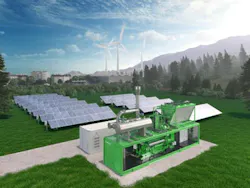
Energy solutions firm Rehlko is banking big on racing demand for flexible power generation by agreeing to a 1.25-GW gas engine capacity deal with INNIO Group.
The multi-year supply deal appears timed to meet “speed to power” demand from data centers and other infrastructure projects around the world. Slower utility grid interconnection delays are leading digital infrastructure firms to seek behind-the-meter and sometimes off-grid projects as alternatives for faster operational startups.
Rehlko, formerly Kohler Power, says the INNIO gas engine supply deal helps it answer demand from hyperscale, colocation and enterprise data center operators. The projects will be handled by Rehlko’s in-house engineering and project delivery subsidiary Clarke Energy.
“This agreement strengthens our ability to support customers making long‑term investments in data‑center infrastructure and flexible power generation,” Rehlko CEO Brian Melka said in a statement. “Securing multi‑year supply enhances visibility and confidence in delivery at a time when demand is being driven by structural, rather than cyclical, market forces.”
The Growing Need for Battery Storage
New Quickhat with Elm Microgrid
Data center demand surge ahead
Research firm Gartner predicts that global data center electricity demand will double by 2030. That digital infrastructure consumption could total 980 terawatt hours (TWh) by that time, according to Gartner.
Clarke Energy has worked closely on projects with INNIO through 30 years and more than 10 GW of gas-engine installations. Austria-based INNIO, which owns and manufactures the Jenbacher and Waukesha engine brands, is quickly stacking a massive line of gas-engine commitments such as the Rehlko agreement and the recent 2.3-GW supply deal with VoltaGrid which itself is contracted for new power by tech giant Oracle.
Rehlko’s three-year agreement with INNIO promises approximately 1.25 GW of gas engine commitment for customers planning multi-phase developments that involve long-term construction, grid connection and operational schedules.
“With this framework agreement, we are strengthening our partnership with Rehlko and creating long‑term planning certainty in a market with rapidly growing demand,” INNIO Group CEO Olaf Berlien said. “It ensures that our customers can continue to rely on proven technology and dependable execution even in highly critical applications such as data centers and grid‑stabilization projects.”
Want resiliency? Get closer
Rehlko CEO Melka has noted that delivering energy resiliency in the future means getting closer to customer loads. This group includes data centers and AI factories, but also commercial development and industrial manufacturing in an era where U.S. energy infrastructure was graded as a lowly D+ last year by the American Society of Civil Engineers.
“What is happening in real time right now is that the utility grid model hasn’t changed in 135 years, and the reality is that model is no longer going to work,” Melka told Microgrid Knowledge in an exclusive interview last year during the RE+ Conference in Las Vegas.
“Whether it’s aging infrastructure, considering that 60% to 70% of that infrastructure needs to be replaced, and demand is changing,” Melka added then. “What’s driving this is for energy production, consumption and management much closer to where the demand is.”
Other data center developers in the U.S. are embracing the nation’s deep natural gas reserves to secure flexible power generation through both gas turbines and reciprocating engine technologies. AI infrastructure firm Crusoe signed up for 4.5 GW of future natural gas power through its joint venture with investor Engine No. 1, while Fermi America, Nscale and other deep-pocketed developers are also forging new alliances with natural gas producers and electricity generators.
Many of these projects are being designed as co-located distributed energy resources to provide prime power and then connect back to the grid later.
“The grid edge is where the action is,” former U.S. Energy Secretary Ernest Moniz said last month during a session at CERAWeek’s New Energies Hub. “They want to add as much captive power as possible. It will lead to a lot more projects behind-the-meter.”
Tulsa-based natural gas infrastructure firm Williams Cos., which owns and operates an interstate system of pipelines serving utilities throughout the southern and eastern U.S., started up its own New Energy Ventures and Power Innovations division to pursue these kinds of accelerated transactions with commercial and industrial sector customers.
“Our natural gas infrastructure is positioned to deliver speed to power,” Jaclyn Presnal, vice president of Williams’ New Energy Ventures Group, said during a later New Energies Hub session Monday afternoon at CERAWeek. Our natural gas infrastructure is positioned to deliver speed to power.
“The pipelines are in place and natural gas is abundant,” Presnal added. “A common request (from new industrial customers) is ‘as fast as possible.’”
A Grid in Peril and Resiliency Lives at the Edge
A New Paradigm for Microgrids
A New E-Book from Microgrid Knowledge
About the Author
 Rod Walton, Microgrid Knowledge Managing Editor
Rod Walton, Microgrid Knowledge Managing Editor
Managing Editor
For Microgrid Knowledge editorial inquiries, please contact Managing Editor Rod Walton at [email protected].
I’ve spent the last 18 years covering the energy industry as a newspaper and trade journalist. I was an energy writer and business editor at the Tulsa World before moving to business-to-business media at PennWell Publishing, which later became Clarion Events, where I covered the electric power industry. I joined Endeavor Business Media in November 2021 to help launch EnergyTech, one of the company’s newest media brands. I joined Microgrid Knowledge in July 2023.
I earned my Bachelors degree in journalism from the University of Oklahoma. My career stops include the Moore American, Bartlesville Examiner-Enterprise, Wagoner Tribune and Tulsa World, all in Oklahoma . I have been married to Laura for the past 36-plus years and we have four children and one adorable granddaughter. We want the energy transition to make their lives better in the future.
Microgrid Knowledge and EnergyTech are focused on the mission critical and large-scale energy users and their sustainability and resiliency goals. These include the commercial and industrial sectors, as well as the military, universities, data centers and microgrids. The C&I sectors together account for close to 30 percent of greenhouse gas emissions in the U.S.
Many large-scale energy users such as Fortune 500 companies, and mission-critical users such as military bases, universities, healthcare facilities, public safety and data centers, shifting their energy priorities to reach net-zero carbon goals within the coming decades. These include plans for renewable energy power purchase agreements, but also on-site resiliency projects such as microgrids, combined heat and power, rooftop solar, energy storage, digitalization and building efficiency upgrades.