Microgrid Resilience Expected to Yield $450K/Year in Savings for Siemens Manufacturing Facility
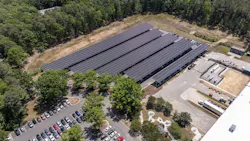
Placing a value on the energy resilience provided by a microgrid isn’t always easy.
Identifying that value, however, can be critical to getting a project off the ground.
Some organizations, such as Clean Coalition, have developed a standardized approach to valuing the resilience provided by community microgrids. In addition, the National Renewable Energy Laboratory has looked at how to monetize resilience.
For a Siemens USA manufacturing facility and office building in the Wendell, North Carolina, headquarters for its U.S. Electrification and Automation business, a few years of outage data helped identify that cost: $450,000 a year, even though total energy costs were only about $180,000/year, said Devin Geckeler, principal key expert for microgrids at Siemens US Electrification and Automation business unit.
The cost is associated with reductions in the company’s production line output during outages, he said. The Wendell facility produces medium-voltage power equipment.
Meeting 100% of the facility’s energy use with renewables
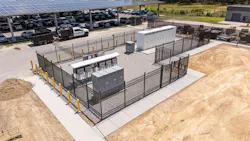
Eliminating that $450,000 in outage costs is a major reason the company installed a grid-connected solar and storage microgrid which operates in island mode. In 2026, Siemens is expected to meet 100% of the facility’s energy needs with renewable energy.
The microgrid is made up of a 1.25 MW solar photovoltaic (PV) carport array and a 3.9 MWh energy storage system. The microgrid began operating in November 2025 and became fully operational in early 2026.
Achieving sustainability goals is the second reason Siemens installed the microgrid. Siemens aims to become carbon neutral across its operations by 2030.
Siemens balances its sustainability and resilience objectives through supply-and-demand optimization, Geckeler said.
Sustainability is expected to come from PV offsetting 100% of the total kWh the facility consumes over the course of a year.
Exporting extra PV to Duke Energy under net metering
Extra PV from the system is exported to Duke Energy under a net metering program.
Under that program, Siemens can’t export more than it consumes over the course of a year.
“We are allowed to export the extra PV and we do that regularly during the day,” Geckeler said. Siemens uses PV to charge the battery in the morning, then uses the battery's energy storage in the evening to offset some of its demand. Once the battery is fully charged during the day, it exports excess PV to the grid.
“That's how we produce enough energy to offset our entire kWh consumed during the year,” Geckeler said.
Siemens reserves 50% of its battery capacity for resilience. During outages, it will black-start the entire facility using the battery.
Siemens created a custom demand response algorithm
The other 50% of the battery capacity is reserved for Duke’s demand response program, which is expected to yield an additional $100,000 in savings, Geckeler said.
Siemens created some custom demand response algorithms that are expected to help provide those savings.
Duke Energy offers off-peak, on-peak and mid-peak time-of-use rates. The Siemens algorithms calculate the optimal demand to offset during the day.
To help meet its sustainability goals, Siemens can curtail the 42 electric vehicle chargers located at the facility to reduce load. It recently added 32 chargers.
The microgrid, paired with other energy-saving measures, is expected to allow the Wendell site to become completely carbon neutral in 2026 and reduce energy consumption from the grid by 2.5 MWh/year. Siemens eliminated gas furnaces and gas cooking appliances as part of this effort.
Working with Duke Energy on new tariffs that allow for more PV
To achieve microgrid benefits, Siemens worked with its utility, Duke Energy, as it developed new tariffs.
Initially, Siemens was only allowed to deploy 1 MW of PV, but added .25 MW when Duke increased the capacity cap.
“Because of the tariff change, we were allowed to have 1.25 MW of PV plus an additional almost 1 MW of battery energy storage,” Geckeler said.
Duke also changed its interconnection study process to allow for larger microgrids to be approved more quickly, Geckeler said.
Siemens is interested in participating in ancillary services programs once they are developed, but none are currently available.
Growing interest in advanced microgrids, especially from data centers
Siemens is seeing growing interest from potential customers in deploying similar state-of-the-art microgrids. Interest is coming from customers in California, Texas and the northeast U.S.
Customers may initially be seeking sustainability, but then often say they’re interested in cost savings and resilience.
“You start talking to them, and they want to have advanced functionality to provide additional benefits from the primary benefit. Usually, adding these additional benefits gives you a better economic return on investment,” he said.
Data center operators are especially interested in microgrids because they need power now, and utilities are slow to interconnect the facilities. Microgrids can serve as a bridge to utility power.
“The utilities can't provide power fast enough, and they are looking at microgrids as an alternative,” Geckeler said.
About the Author
 Lisa Cohn
Lisa Cohn
Contributing Editor
I focus on the West Coast and Midwest. Email me at [email protected]
I’ve been writing about energy for more than 20 years, and my stories have appeared in EnergyBiz, SNL Financial, Mother Earth News, Natural Home Magazine, Horizon Air Magazine, Oregon Business, Open Spaces, the Portland Tribune, The Oregonian, Renewable Energy World, Windpower Monthly and other publications. I’m also a former stringer for the Platts/McGraw-Hill energy publications. I began my career covering energy and environment for The Cape Cod Times, where Elisa Wood also was a reporter. I’ve received numerous writing awards from national, regional and local organizations, including Pacific Northwest Writers Association, Willamette Writers, Associated Oregon Industries, and the Voice of Youth Advocates. I first became interested in energy as a student at Wesleyan University, Middletown, Connecticut, where I helped design and build a solar house.
Twitter: @LisaECohn
Linkedin: LisaEllenCohn
Facebook: Energy Efficiency Markets