Hybrid Microgrid Cuts Generator Runtime in Army Exercise
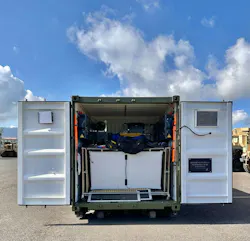
Army researchers testing a commercially developed Rapid Deployment Hybrid Microgrid (RDHM) in the Philippines found it reduced generator use by an estimated 30% to 50%, according to early results.
Built by Tennessee-based Resilient Energy & Infrastructure (REI), RDHMs are containerized microgrids designed to provide reliable, adaptable power for soldiers operating in a variety of environments. The modular systems include generation, battery storage, power distribution and energy management.
“For the warfighter, energy has to be available where the mission happens, not simply where the infrastructure happens to exist,” Paul Maloney, founder of Resilient Energy & Infrastructure, said in a statement. “Our objective with RDHM is to give commanders a modular energy capability that can move with the force, operate independently when necessary, and connect with other systems when the mission requires it.”
In addition to mobile units like the RDHM, the U.S. military is actively building fixed microgrids at military installations around the world.
Improvements driven by real-world test results
The U.S. Army Combat Capabilities Development Command (DEVCOM) Army Research Laboratory (ARL) tested the hybrid microgrid during this year’s Exercise Balikatan, an annual joint military exercise between the Philippines and the U.S.
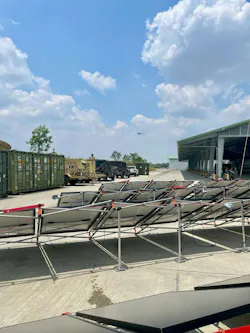
The researchers looked at whether the system could supply steady power to command-and-control systems, communications, and sensor equipment, while reducing the military’s reliance on generators. Fuel resupply can be complex and risky, especially for units operating in remote or contested areas far from established supply lines.
Results indicated that the system could reduce generator runtime by an estimated 30% to 50%. The microgrid uses battery storage and automated energy management, which can buffer rapid shifts in power consumption and reduce how often generators need to run.
They also found that RDHMs can extend “silent watch” capability from minutes to several hours, depending on mission demand and system configuration. Silent watch refers to operations in which troops shut down generators, so the noise and heat don’t reveal their position while they observe an area.
“Balikatan gave us the opportunity to move this technology beyond the laboratory and put it into an operational environment where Soldiers have the opportunity to employ it,” Jake Strahan, ARL experimentation lead, said in a statement. “From a research perspective, that’s where we learn what works, what needs adjustment, and how RDHM can contribute to the way our formations operate across the vast Pacific.”
Soldiers participating in the test provided feedback on the setup, integration and performance of the system, giving Army researchers valuable feedback before it commits to putting the microgrids in the field.
“Data and warfighter feedback collected during operational events are key to informing system configuration, manufacturing, training and future acquisition decisions,” Andre Slonopas, ARL program lead, said in a statement. “If we expect formations to operate dispersed, remain mobile and continue the mission when logistics and infrastructure are contested, then the energy architecture has to be just as resilient as the systems it supports. RDHM is about building that resilience into the force from the beginning.”
Advancing to the next stage
The Army Small Business Innovation Research (SBIR) program provided funding for the RDHM’s initial development. SBIR provides small businesses that are developing technologies with civilian and military applications access to government funding opportunities. The Department of War’s Accelerate the Procurement and Fielding of Innovative Technologies (APFIT) program later supported its development.
REI was recently awarded a contract worth up to $49 million to supply the Army with RDHMs, though final spending will depend on orders placed through 2031.
The Army and National Guard plan to buy the systems for National Guard units, special operations forces and the 3rd Multi-Domain Task Force, according to the Army Research Laboratory. The task force integrates cyberspace, space, land, sea and air operations.
“We are working to translate fundamental research in energy storage, power electronics and autonomous controls into capabilities that soldiers need,” Slonopas said. “Exercises such as Balikatan give us the operational insight needed to understand how these systems perform, where they need improvement and how they may inform future Army decisions.”
About the Author
 Kathy Hitchens
Special Projects Editor
I am a writer and special projects editor for Microgrid Knowledge. I have over 30 years of experience covering the renewable energy, electric vehicle, utility, technology, entertainment, education, and financial sectors. I have a BFA in Media Arts from the University of Arizona and a MBA from the University of Denver.
Related
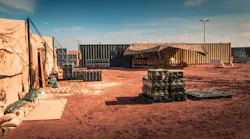
 Soldiers from the 14th FH working on the Microgrid System setup and connections during an operational test conducted by the U.S. Army Test and Evaluation Activity at Fort Stewart, Georgia on Nov. 5, 2023. (Photo Credit: Jose Rodriguez, U.S. Army Medical Center of Excellence)