“Triple Threat” Pumped Storage Hydro plus Solar, Storage and Biofuel Microgrids Supported by $73 million in PG&E Funding
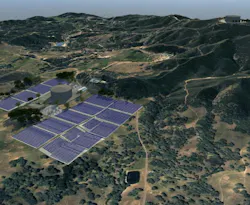
Wildfires and power outages prompted Lake County, Calif. to find a renewable technology that provides resilience and supports the grid.
Three pumped storage hydro facilities serving as microgrids could solve all three challenges, according to Michael Day, comprehensive solutions account executive at Trane Energy Services, which is developing the storage systems for the county.
This idea, dubbed “Firemain Linked Auxiliary Supply/Hydraulic Energy Storage,” is being backed–along with other projects– by Pacific Gas & Electric’s (PG&E) Microgrid Incentive Program under its latest round of funding.
“These are actually triple threat, multi-use public infrastructure,” Day said. “Their daily job is to make renewable electricity, store it and support the grid during peak hours.” As a bonus, they can provide water for firefighters battling blazes.
PG&E’s latest MIP funding includes six new projects
PG&E signed grant agreements with four project developers, some of whom applied during the first round of funding–including Lake County. During that first round, PG&E awarded $43 million for nine initial projects.
In the second round, the utility chose six new projects for community microgrids across Northern and Central California. Together, the projects represent more than $73 million in community microgrid investments.
The projects include solar, storage, biomass and biodiesel technologies, along with pumped storage hydro.
The utility expects to open a third round of applications in 2027, and $10 million is available for that round through MIP. That number could increase if some project developers pull out of the program, said PG&E spokesman Paul Doherty.
For every dollar PG&E provides for these awarded projects, the project participants are anticipating finding $6 from other sources.
All the projects are front-of-meter that can provide at least 24 hours of outage coverage in island mode.
Pumped storage hydro microgrids that don’t use dams
The pumped storage hydroelectric facilities differ from traditional pumped storage projects that use dams to generate electricity, said Madison Hoffacker, project manager at PG&E. Lake County will place water tanks at the top and bottom of a hill, and during off-peak hours, they’ll use solar to pump water in the lower tank to the top tank. During high-demand periods, the projects–one 10-MW solar/40-MWh storage and two 20-MW solar/80-MWh storage facilities– release the water and it will spin turbines that produce electricity, she explained.
The three microgrids would serve the northwest shore of Clear Lake, from North Lakeport to Nice, as well as portions of the Hidden Valley Lake area.
The projects will supply capacity to the California Independent System Operator year-round. The county has not yet decided whether it will own the pumped storage projects or sell them to an investor, Day said. The MIP funds will pay for a feasibility study that will help them decide between the two options.
PG&E’s MIP can pay for engineering and project management costs to help get projects off the ground, along with land purchases or land leases, Hoffacker said.
MIP awardees qualify for additional funding
MIP awardees also qualify for up to $3 million in Community Microgrid Enablement Program (CMEP) funding, which covers the cost to study the microgrid or for utility upgrades required to create the microgrid.--reclosers and controllers, for example.
PG&E chooses projects based on a system that scores them on community, resilience and environmental benefits, Hoffacker said.
One of the projects that received funding through the second application window is the Pescadero Community Microgrid.
Peninsula Clean Energy plans a 100% solar-powered community microgrid to provide resilience to the town of Pescadero that would serve more residents and organizations than any other community microgrid in California, planners say.
The town of Pescadero is a disadvantaged community–where median household Income is below 80% of the statewide average–plagued by wildfires, outages, flooding and public safety power shutoffs. A remote coastal community in unincorporated San Mateo County, the town sits at the end of a local feeder, and residents face frequent outages that sometimes last weeks.
The MIP program allocated $79.2 million to PG&E, $83.3 million to Southern California Edison, and $17.5 million to San Diego Gas & Electric. The utilities will receive $20 million, divided among the three, to cover program administrative costs.
MIP program drawing investor interest
For PG&E’s first application window, the utility received about 50 different project proposals, Hoffacker said. Many of them dropped out, perhaps because, after a rigorous technical consultation, they decided they weren’t eligible or weren’t prepared, she said. Twenty-two project developers applied for the MIP, and nine were chosen.
During the second round, PG&E received 66 project proposals. The utility chose 26 for technical consultation, and ultimately, 20 developers applied for funding. PG&E chose six of those projects for funding, she said.
Award amounts range from $2 million to $6 million per project.
Under the program, a simple microgrid may take about three years to get up and running. Complex projects may take about five years, Hoffacker said.
Despite the deployment timeline, investors have expressed interest in the program.
“A lot of the project's funding are coming in from anticipated investors,” Hoffacker said. “They see that because these are front-of-meter resources that are market-participating, there's an opportunity for investment.”
Time to Power Up Those Hot Topics
Microgrid Knowledge Call for Speakers open til next week
Submit your session ideas now
About the Author
 Lisa Cohn
Lisa Cohn
Contributing Editor
I focus on the West Coast and Midwest. Email me at [email protected]
I’ve been writing about energy for more than 20 years, and my stories have appeared in EnergyBiz, SNL Financial, Mother Earth News, Natural Home Magazine, Horizon Air Magazine, Oregon Business, Open Spaces, the Portland Tribune, The Oregonian, Renewable Energy World, Windpower Monthly and other publications. I’m also a former stringer for the Platts/McGraw-Hill energy publications. I began my career covering energy and environment for The Cape Cod Times, where Elisa Wood also was a reporter. I’ve received numerous writing awards from national, regional and local organizations, including Pacific Northwest Writers Association, Willamette Writers, Associated Oregon Industries, and the Voice of Youth Advocates. I first became interested in energy as a student at Wesleyan University, Middletown, Connecticut, where I helped design and build a solar house.
Twitter: @LisaECohn
Linkedin: LisaEllenCohn
Facebook: Energy Efficiency Markets