For These Western New York Local Governments, Microgrids Viewed as Critical Infrastructure

In Western New York, it’s especially important to ensure resilience in the face of intense snowstorms that can spark power outages. For two local governments, microgrids are expected to provide that resilience, protecting critical services such as health care facilities, police stations and fire departments.
More and more local governments–looking to update their old backup power equipment–prioritize microgrids as critical infrastructure, said Jeff Bonerb, a project lead for microgrid provider e2Companies.
E2 this month is expected to deploy a microgrid in Erie County, in response to a deadly blizzard in 2022 that knocked out power for up to four days. The microgrid–funded in part by a 40% Investment Tax Credit–will keep power flowing, lower capacity charges and improve air quality by eliminating the need for a diesel backup generator.
Now e2 has signed an agreement with Wayne County, located nearby in Lyons, N.Y., for a microgrid that will be tied into an existing substation and serve a campus that includes emergency response services, a nursing home, and police.
Governments are more mission-critical than data centers
“This is critical human infrastructure,” said Bonerb. “The county needs these facilities to be resilient. It’s as mission critical as it gets, more mission critical than data centers. Everybody's talking data centers, but government municipalities need these facilities to operate with a high degree of reliability.”
Local governments in New York State have been watching the Erie County project, and many are reaching out for information about how they can boost resilience, he said.
The need extends beyond Western New York. A map from e2 on regions most in need of resilience points to localized capacity constraints, especially for the New York Independent System Operator (NYISO), due to the retirement of aging peaking units and load growth beginning this year.
Communities taking action on resilience
In a growing number of states, especially in the Pacific Northwest, communities are grappling with an aging grid that's growing more vulnerable to extreme weather. They’re also challenged by precautionary power shutoffs by utilities during wildfire season and are focusing on resilience.
For example, Sulis Energy has deployed microgrids for the Swinomish Indian Tribal Community and the Orcas Center, a community and performing arts complex on Washington’s Orcas Island. And Portland General Electric partnered with the city of Beaverton on a microgrid at the Beaverton Public Safety Center.
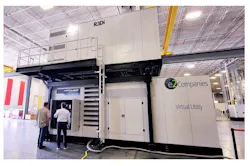
In Wayne County, the microgrid from e2 will serve a campus with multiple buildings that now have backup diesel generators. The system is likely to be 2 to 3 MW, delivered by e2’s R3Di system (pronounced "ready"), which combines power generation with lithium-iron phosphate battery storage.
“The batteries essentially provide an uninterruptible power source to the facility, in this case a campus, where if there is a loss of grid power, essentially across the whole campus for all the buildings, the system will instantaneously island and take over the entire load of the entire campus setting,” Bonerb said.
The system’s generator provides long-duration power, added Neil Cowan, head of marketing and design at e2Companies.
With 100% uptime via the microgrid, the county won’t have to worry about turning on generators at individual buildings. Eliminating diesel generators also improves air quality, he said.
E2 just signed a contract with Wayne County, is now evaluating options for the microgrid and doesn’t yet have an installation date.
Reaping income with the microgrid
In addition to providing resilience, e2’s system will operate the microgrid in revenue-generating mode. If NYISO or a third-party provider needs power, the facility will be placed in island mode. The microgrid may also participate in the state’s Value of Distributed Energy Resources program, Bonerb said.
E2 is also evaluating adding electric vehicle (EV) charging and solar to the microgrid if the right incentives and rebates are available. Ultimately, the county will make that decision, he said.
In Erie County, the project will include 18 EV charging stations. E2 expects to reduce peak charging and other peak uses by using the R3Di system's 2 MW of battery power during peak hours.
Using the batteries to flatten the load and avoid demand and capacity charges is expected to improve efficiency for the Erie County facility by 35%.
The Erie County project has sparked interest in resilience from government agencies across the state, Bonerb said.
“I've met with commissioners from Western New York, Central New York, downstate, all the way out to Nassau and Suffolk Counties,” he said. “We've engaged with and continue to help these commissioners understand the benefits of deploying on-site microgrids.”
Explore Forces Driving the Next Era of Microgrids and DERs
New and Free E-Book by Microgrid Knowledge
About the Author
 Lisa Cohn
Lisa Cohn
Contributing Editor
I focus on the West Coast and Midwest. Email me at [email protected]
I’ve been writing about energy for more than 20 years, and my stories have appeared in EnergyBiz, SNL Financial, Mother Earth News, Natural Home Magazine, Horizon Air Magazine, Oregon Business, Open Spaces, the Portland Tribune, The Oregonian, Renewable Energy World, Windpower Monthly and other publications. I’m also a former stringer for the Platts/McGraw-Hill energy publications. I began my career covering energy and environment for The Cape Cod Times, where Elisa Wood also was a reporter. I’ve received numerous writing awards from national, regional and local organizations, including Pacific Northwest Writers Association, Willamette Writers, Associated Oregon Industries, and the Voice of Youth Advocates. I first became interested in energy as a student at Wesleyan University, Middletown, Connecticut, where I helped design and build a solar house.
Twitter: @LisaECohn
Linkedin: LisaEllenCohn
Facebook: Energy Efficiency Markets